HOW TO BUILD
A FREIGHT WALL.
Every rule the simulator enforces, in the order you meet them. This is what a loader learns in their first week on a dock, written down, which is not something that normally happens.
Learn it in this order
Watch the trainer, load the trainer's wall yourself, then load at pace.
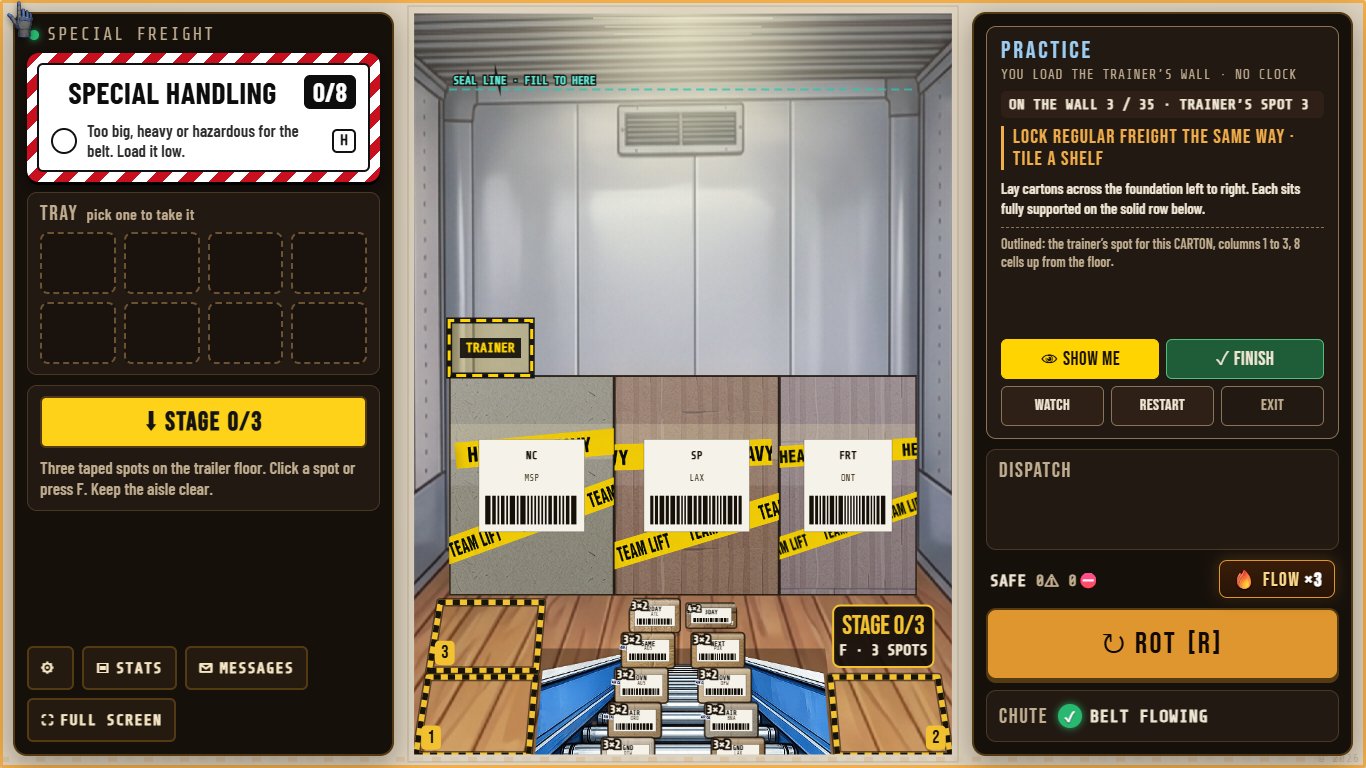
TRAINING builds one complete wall in front of you, one placement at a time, with the reason for the key moves. PRACTICE hands you the same freight in the same order: you place every piece under the same loading rules, with no clock and no score, and SHOW ME outlines where the trainer put the piece in your hand. TRAILER-LOAD is the real tempo, with the clock and the paperwork. The rules on this page are what all three are checking.
In a class? Your instructor gives you a crew code. On the menu choose JOIN A CREW, type the code, then your name and a 4-digit PIN. There is no account and no email. Instructors: the staff guide shows every screen.
The bay
Seventeen cells wide, twenty tall. Row zero is the ceiling.
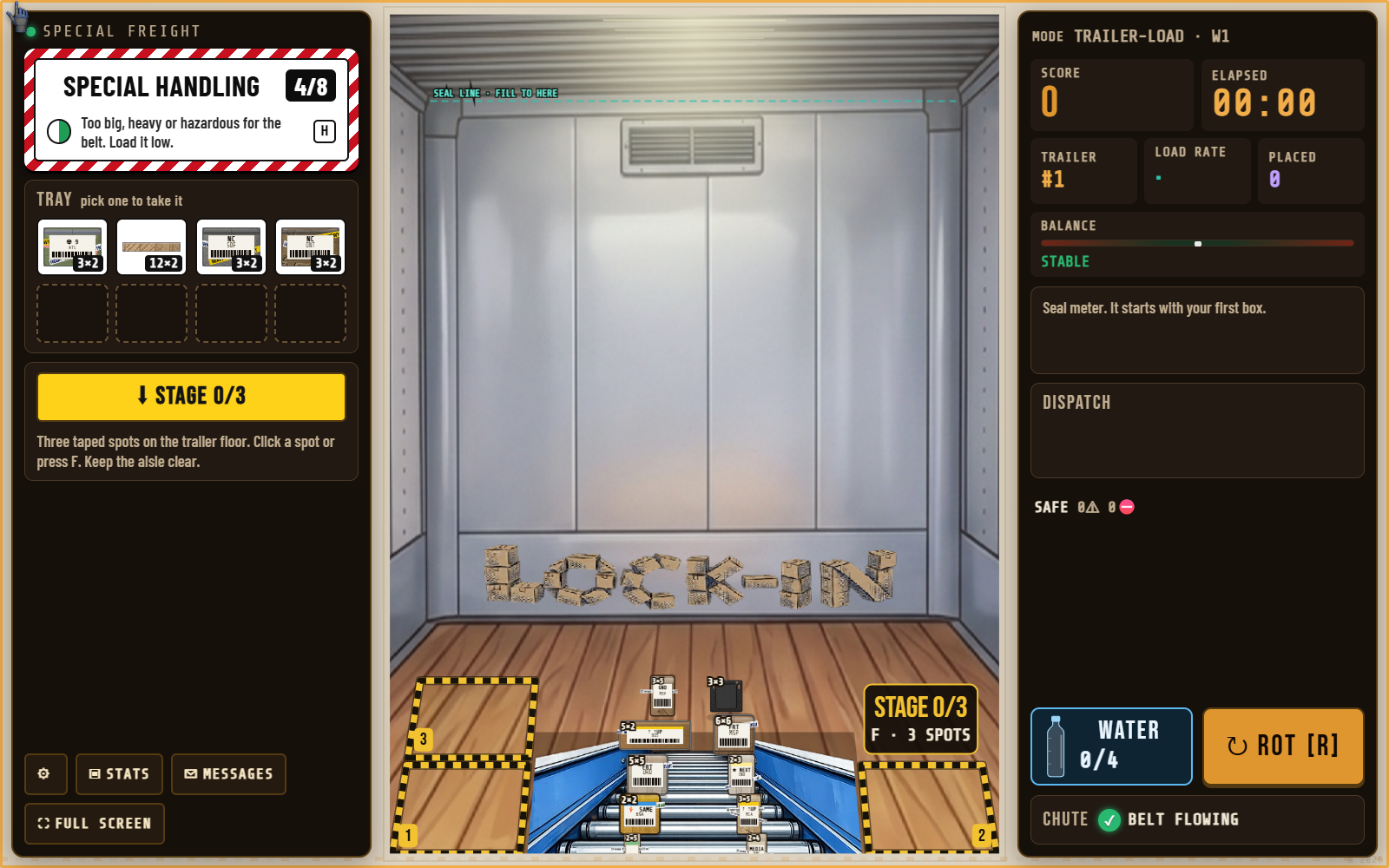
Three hundred and forty cells. You are filling a wall from the floor up, and the wall seals once it passes the seal line, 92% of the height, with at least 35% of the bay packed. Everything below is measured from the ceiling down, so when a rule says a piece must ride low, it means a high row number.
Where freight comes from
Two. The belt, and the special handling rack beside it.
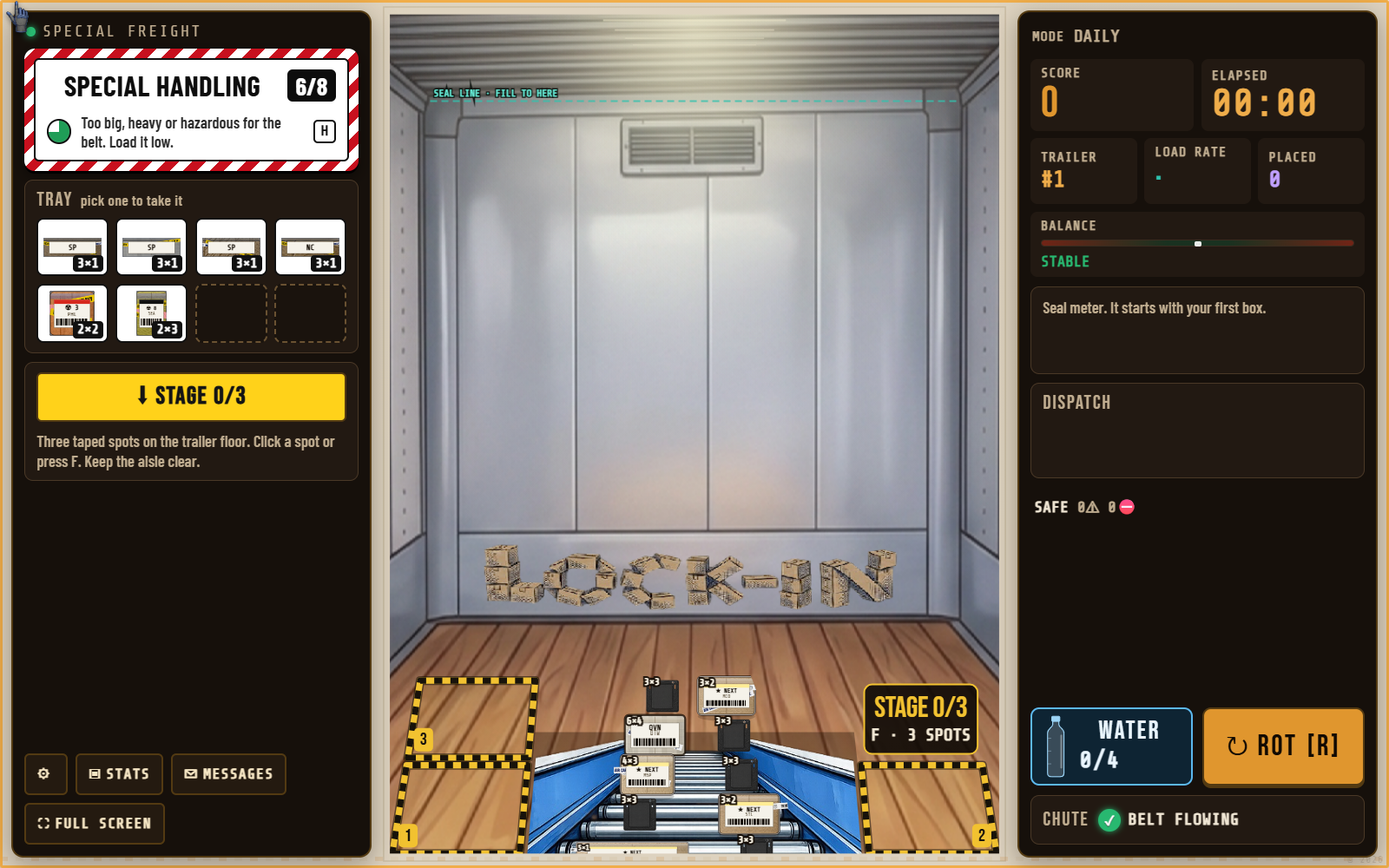
| Source | What arrives | How it behaves |
|---|---|---|
| The belt | 10 visible | Boxes, and the occasional bag of smalls. The front piece is free to take. |
| Special handling | 6 in the daily | Four tires and two hazmats of different classes. They are there from the start and they are the only pieces that earn anchor bonuses. In Trailer-Load the rack carries over from the last wall. New pieces only top it up to four at the start of a wall, and more arrive as you load. |
The daily's special handling is set from the date, so every player on Earth opens the day with the same four tires and the same two hazmats. Nothing else arrives on the rack during the daily wall. What you see at the start is the whole supply, and planning around it is most of the job.
Taking from the back costs you
Reaching past the front of the belt to grab something you like better is charged per piece you reach through. Cherry-picking is a real habit on a real dock and it is a real drag on throughput.
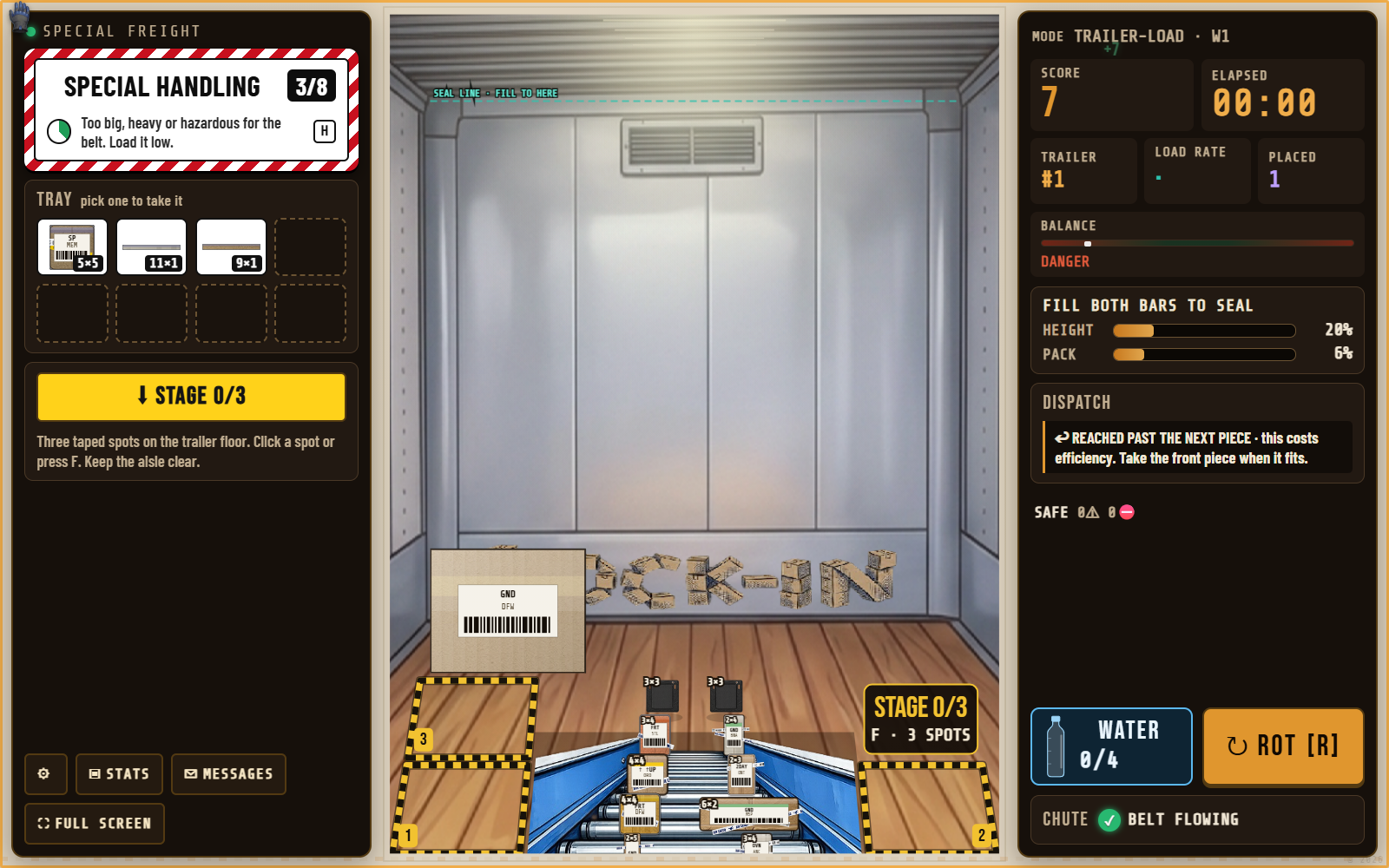
Support
Three quarters of it needs something underneath. Or: both shoulders braced and one foot down.
That is the whole rule, and it has two halves. Most people find the first half in their first minute and never find the second.
The second half, exactly. A piece with less than three quarters underneath still goes down if all three of these are true at the same time: something is touching it on the left, something is touching it on the right, and at least one of its bottom columns is resting on something. It is not floating. It is bridging, with one point of contact below and pressure on both sides.
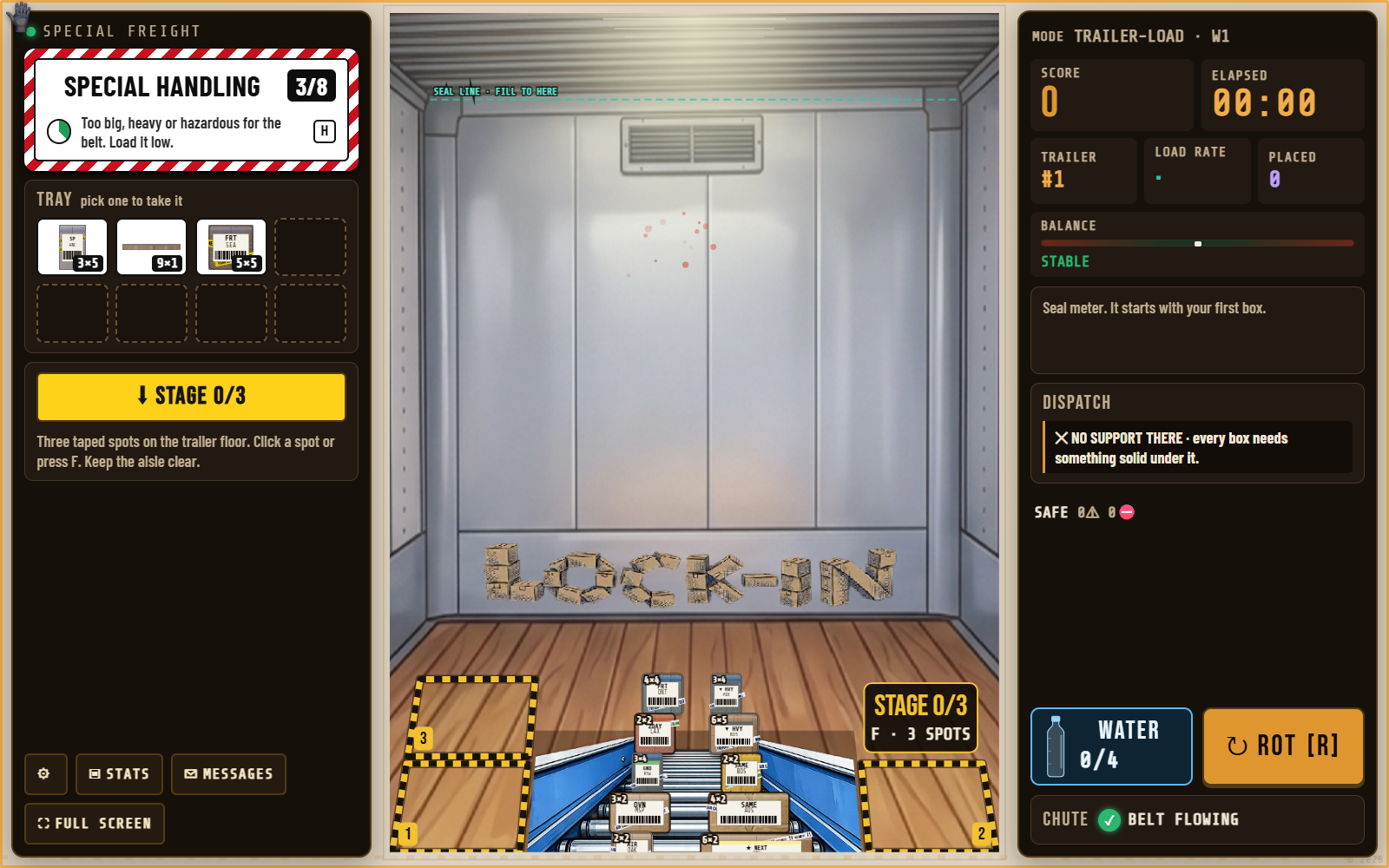
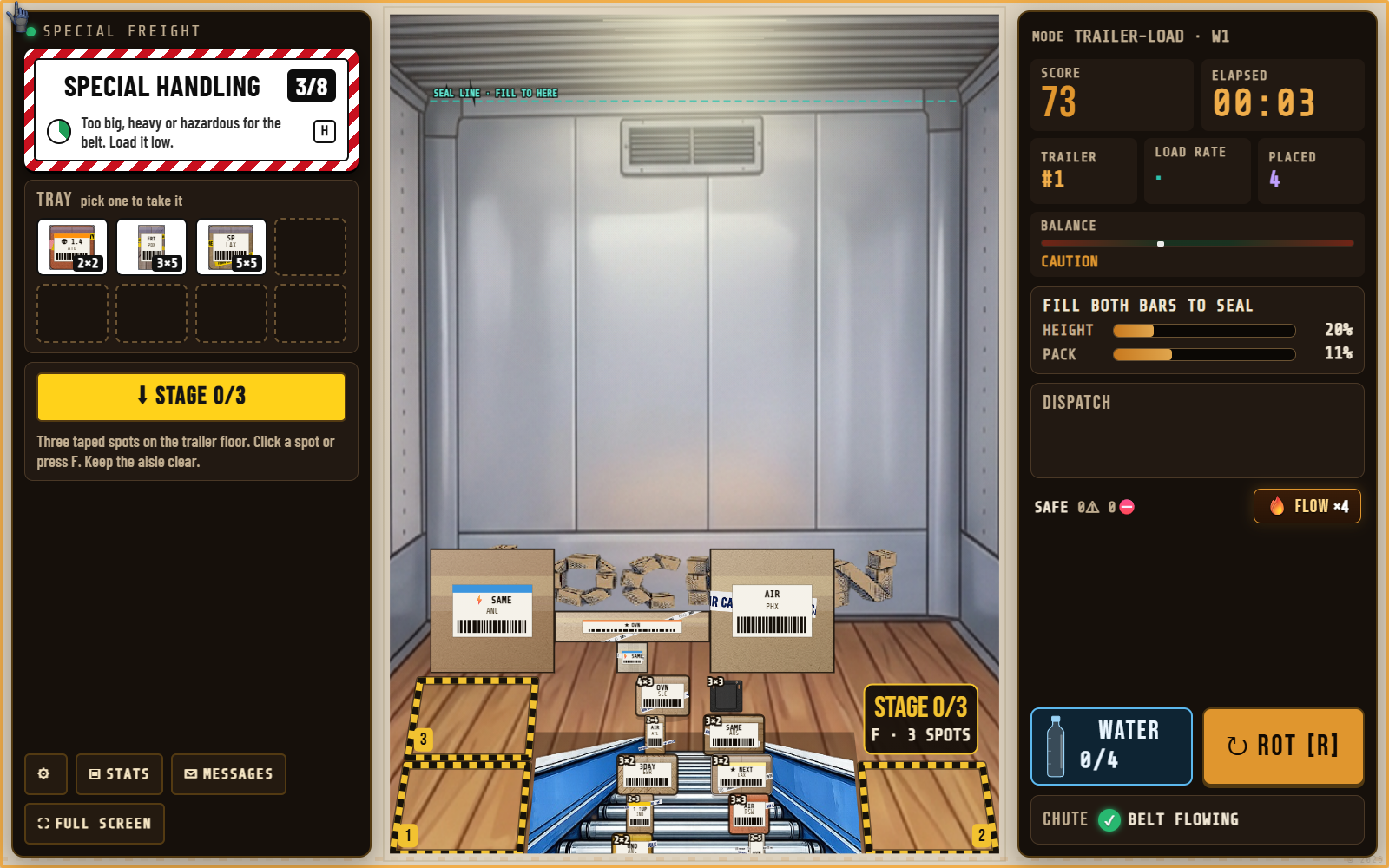
A box braced hard on both sides is held by friction and pressure, not by what is under it. Loaders use this constantly to close a gap that nothing fits cleanly into. The simulator models it because the building does.
The shelf
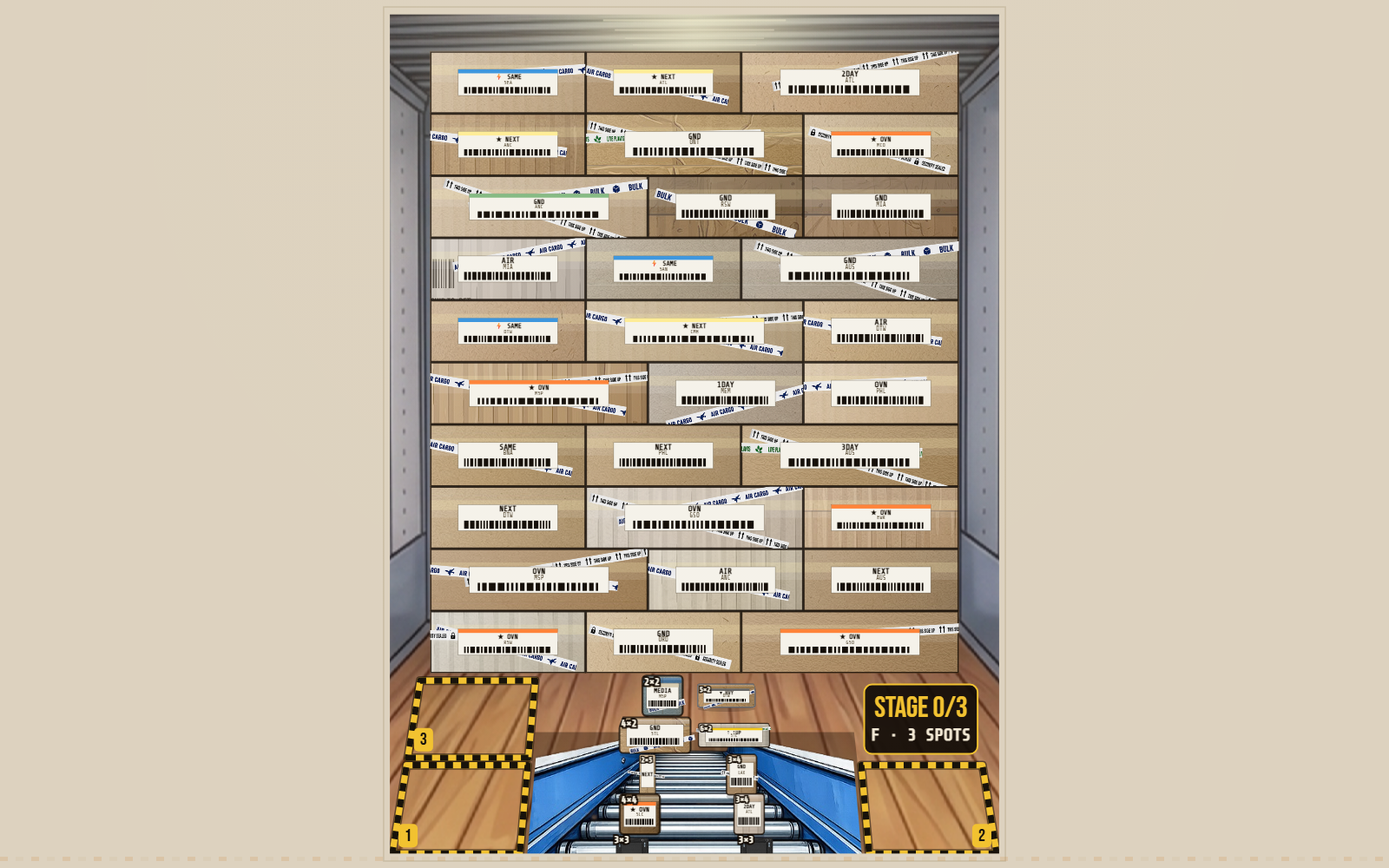
Fill all seventeen cells of a row and it locks. This is the whole job.
A locked shelf is not just points. It changes the physics of everything above it.
- It heals the wall's integrity on the spot.
- It sets a floor under ordinary wear. The floor does not hold for an exposed fragile carrying weight class 4 or more, unless the shelf is at or below that fragile, and a collapse can drop the wall under it until the next placement.
- It protects everything above it from being crushed, for as long as the row stays full. A collapse that takes a piece out of it takes the lock with it.
- It reduces the penalty carried by every piece sitting on top of it.
| Shelves locked | Integrity cannot fall below |
|---|---|
| 1 | 15 |
| 2 | 30 |
| 3 | 45 |
| 4 | 55 |
| 5 or more | 65 |
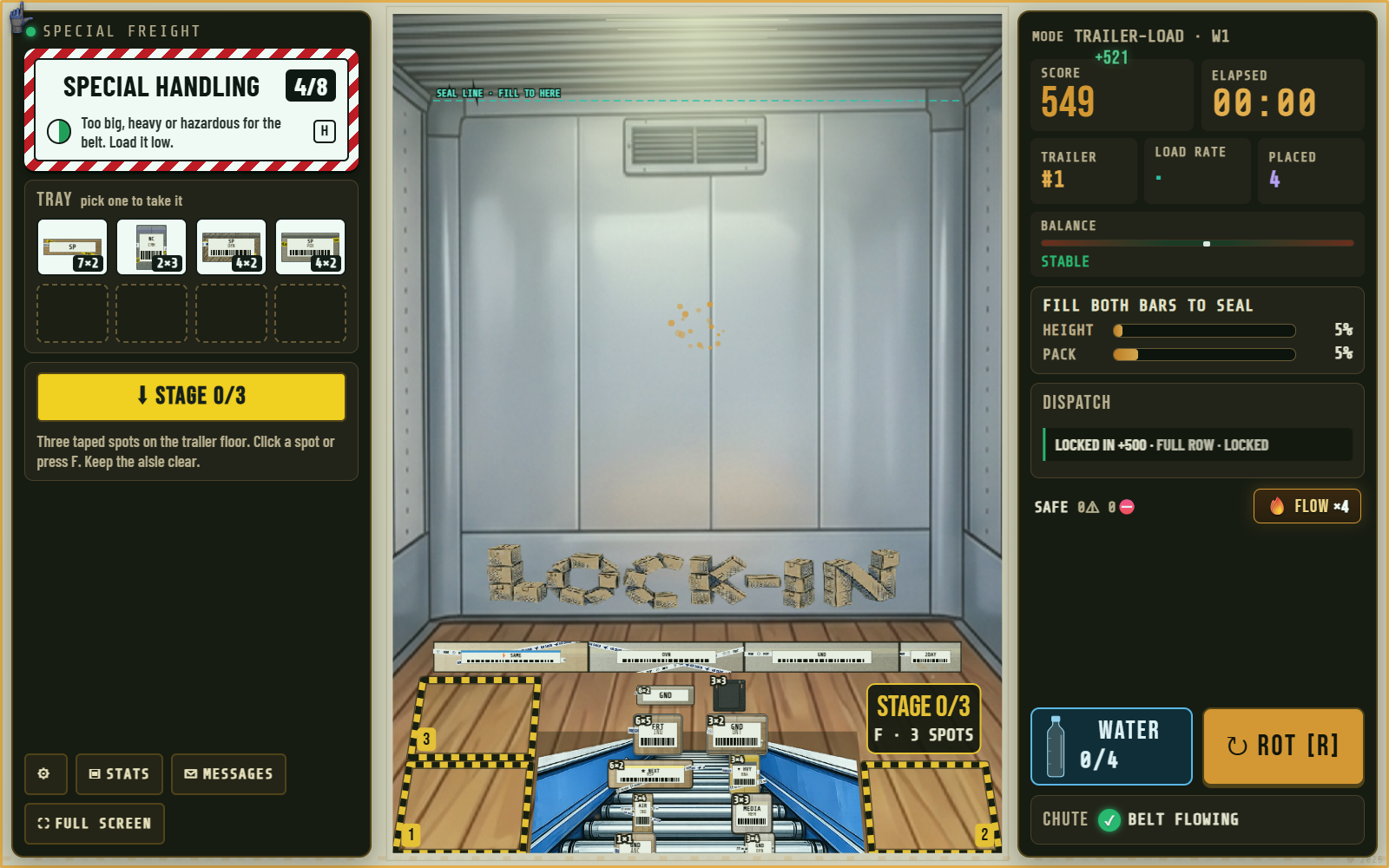
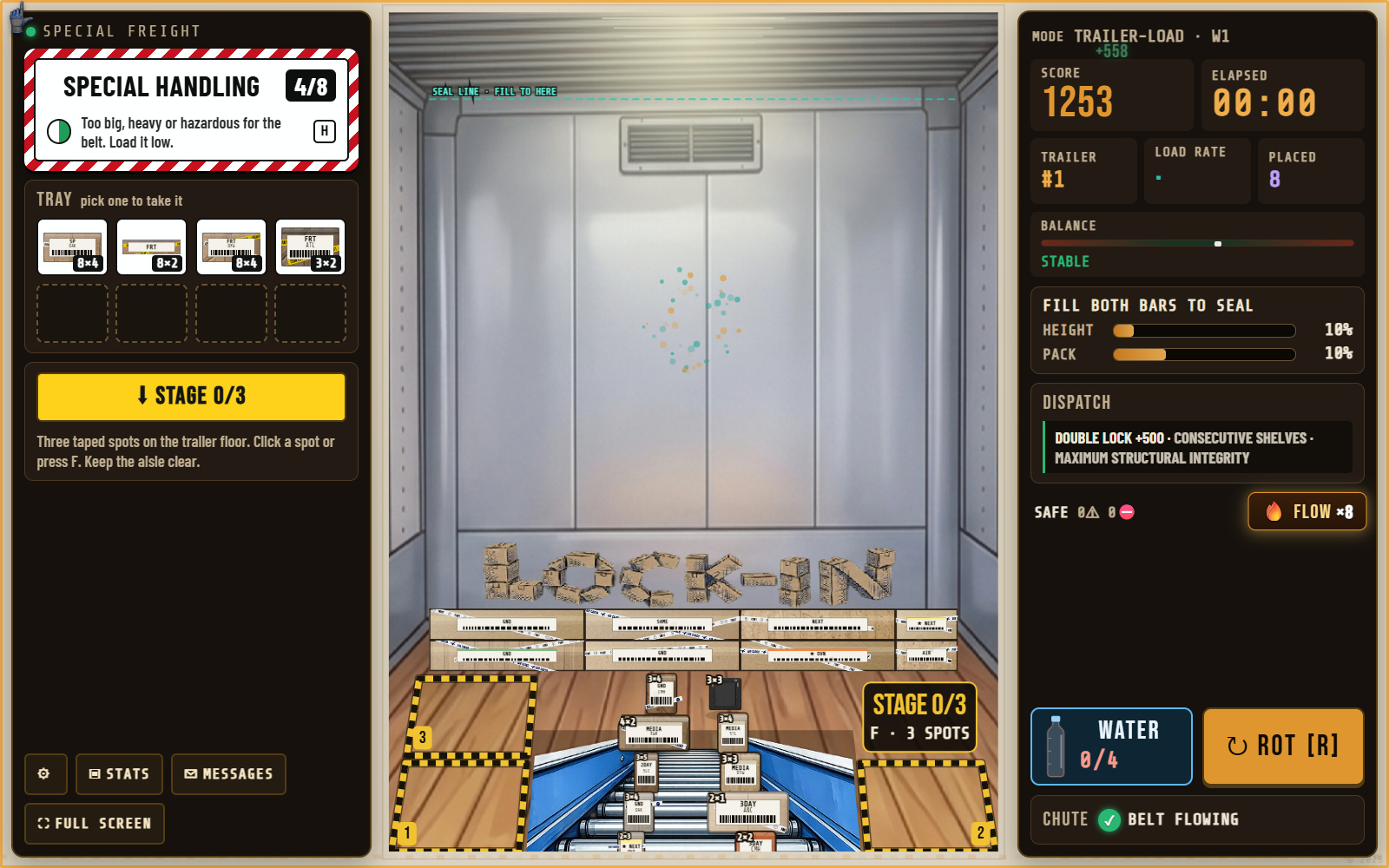
Stagger your courses
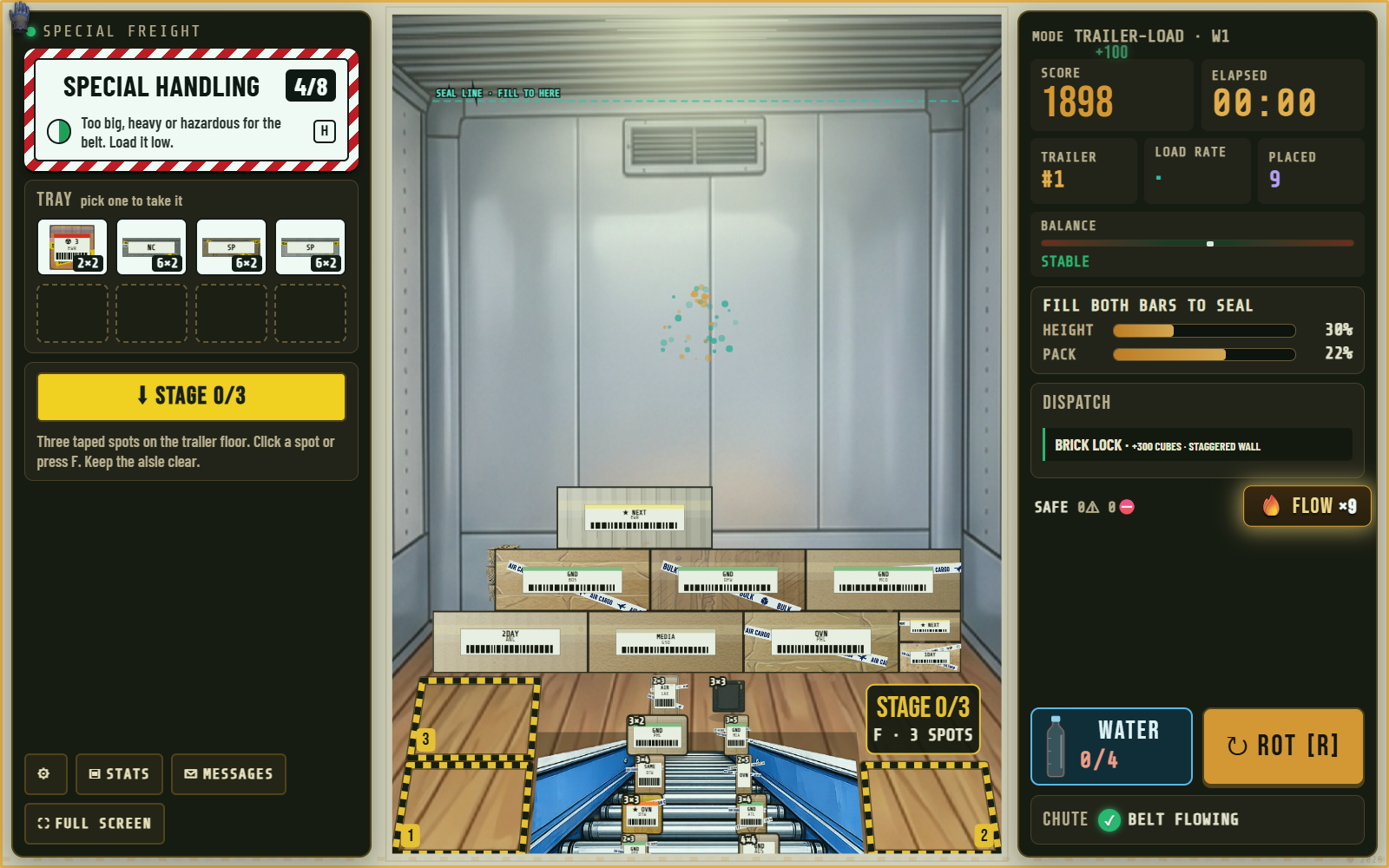
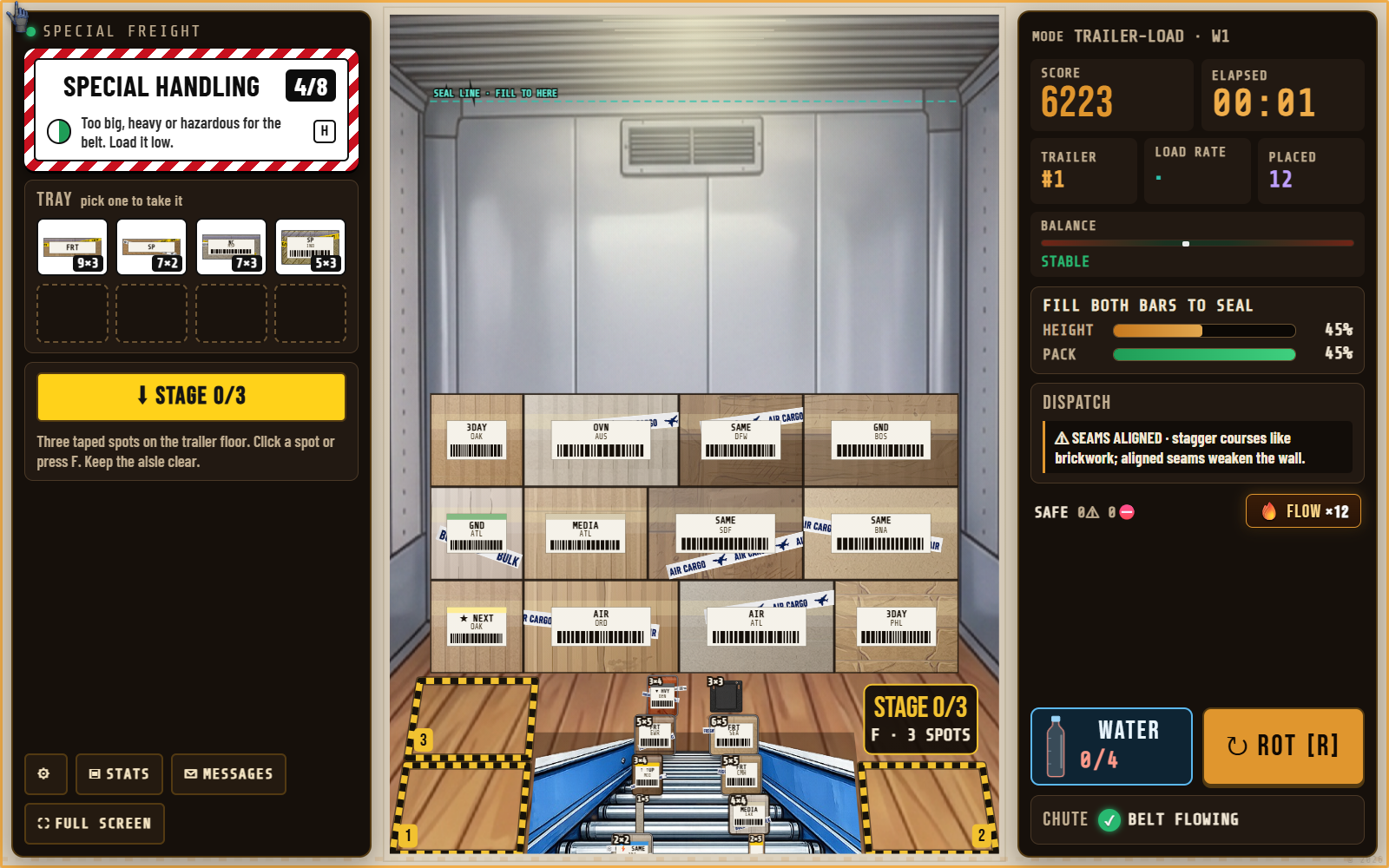
Three or more same-width pieces stacked in a perfect vertical column make a fault line straight up the wall, and it is penalised. Offset each course sideways from the one under it, the way a bricklayer does. Four pieces each offset one to three cells from the piece under them earn a brick lock, once per wall.
Fragile
You have been told fragile rides on top. That is incomplete, and it is why people lose fragiles on row three.
Here is what actually happens. Only the heaviest class of freight, weight class 5, crushes anything. A mid-weight crate does not crush a fragile, but anything weight class 4 or heavier left resting on an exposed fragile makes the wall shed (collapse 7 below). A fragile is safe, at any height, if any one of these is true:
- A full shelf is locked anywhere below it. Lock one row and everything above it is protected for the rest of the wall.
- Its own row is a complete shelf.
- It has a real box on its left and a real box on its right.
The trailer wall is not a box. A fragile pressed against the left or right wall can never earn side protection, because there is nothing on one side to brace it. The corners are the dangerous place, not the safe one.
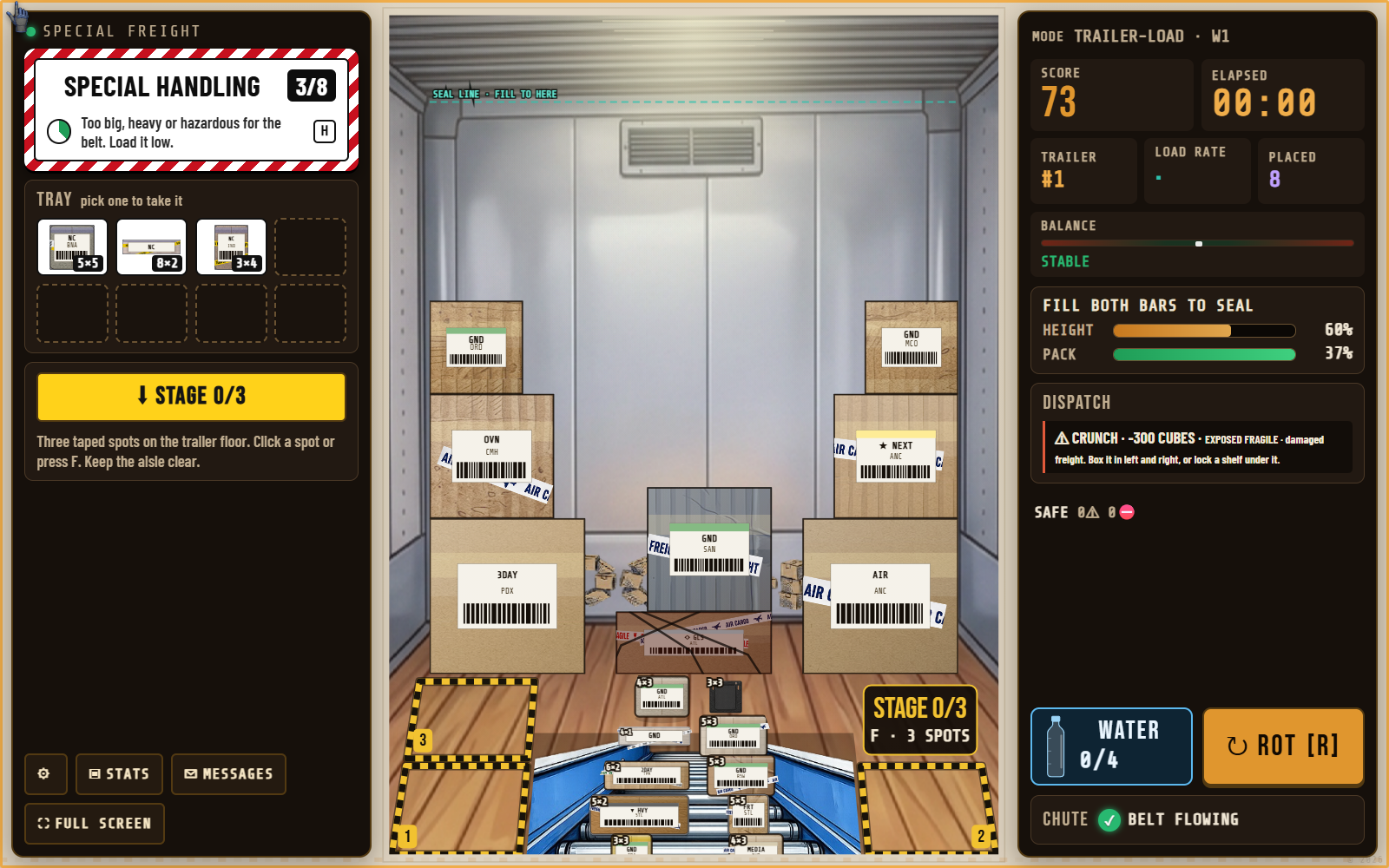
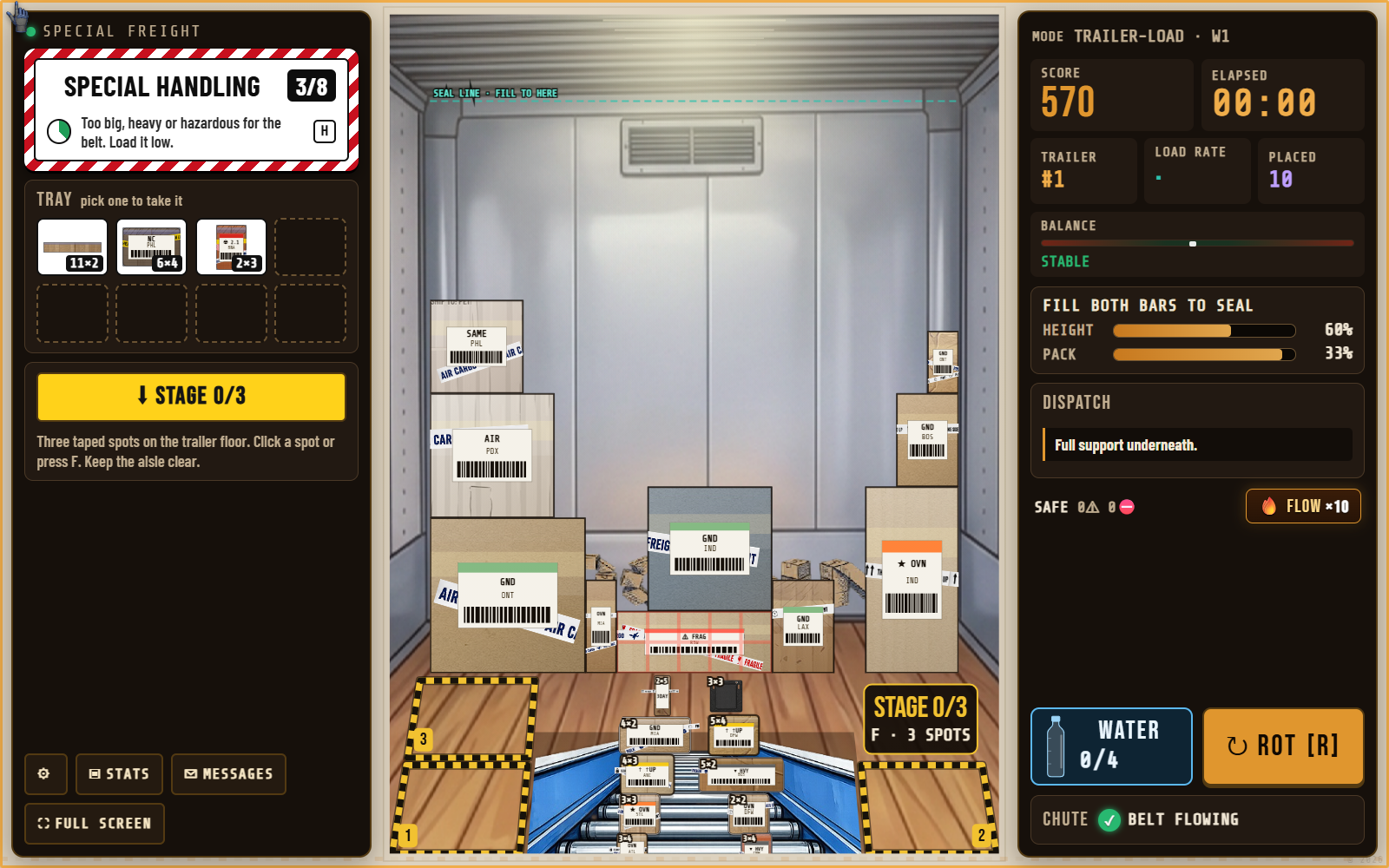
You do not need height. You need a closed course. Build fragiles into the middle of a row, put something flush on each side, and finish the row. A bag of smalls, its loose pieces, any small package and a hazmat count as crushable too, so the same rule protects your customers' packages.
Hazmat
Dangerous goods load low, stay apart, and get capped. Three rules, three consequences.
| Rule | What it means |
|---|---|
| Height | Below the waist line, which is the bottom half of the bay. Any part above it is a violation. |
| Segregation | Two different hazard classes need two clear cells between them, and no more than two pieces of one class may touch. That is the dock rule, stricter than the federal table (49 CFR 177.848). |
| Killer pairs | The pairs the federal table (49 CFR 177.848) keeps apart so a leak cannot mix them, such as an oxidizer with a flammable liquid, and a corrosive liquid may never ride above an oxidizer. Closer than two clear cells, or a corrosive above an oxidizer, is an automatic write-up. |
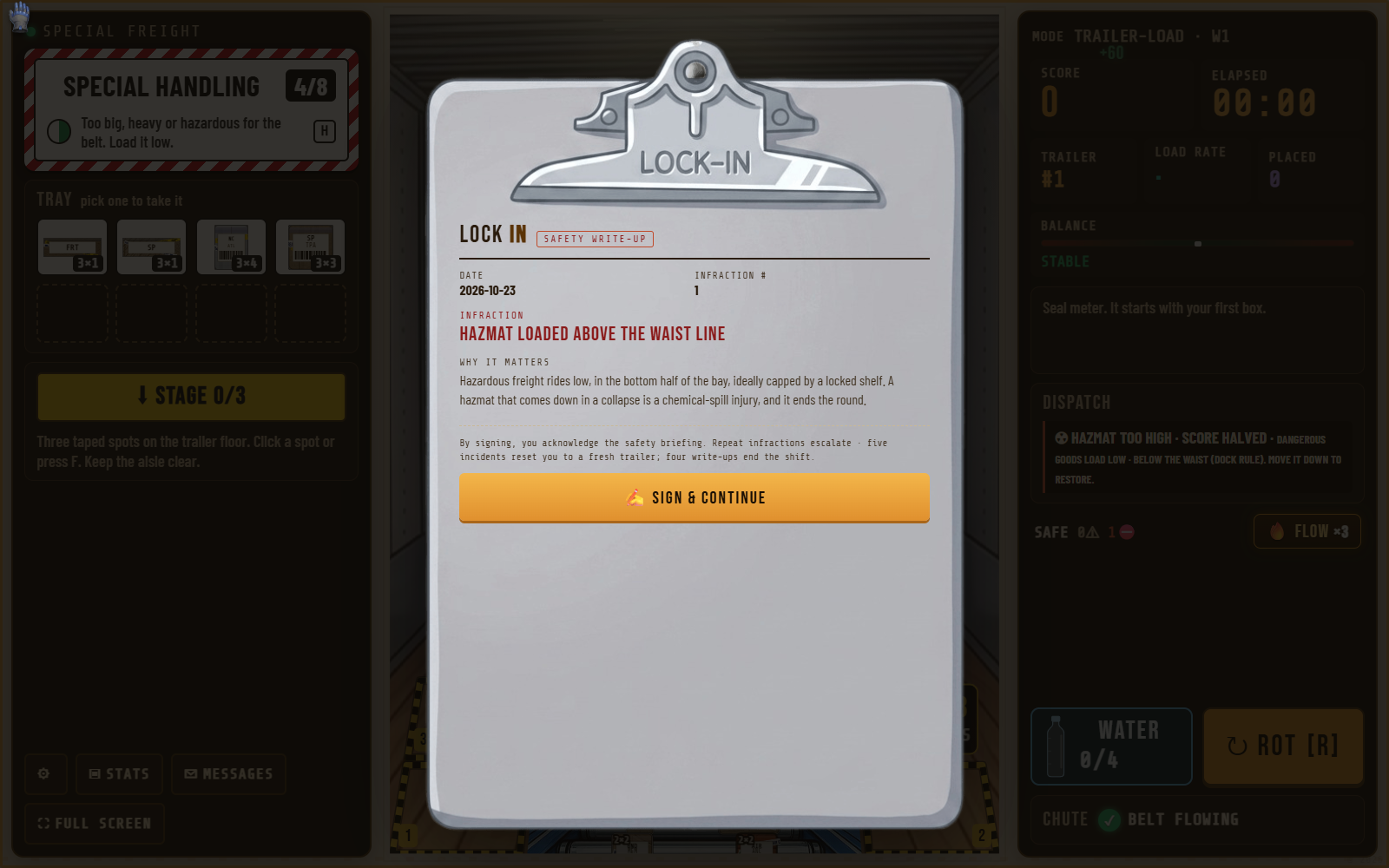
Height and segregation both cut your score hard, and both are checked live. Move the piece and the score comes back. The record does not: a hazmat placed high, two classes too close, or a killer pair is written up the first time.
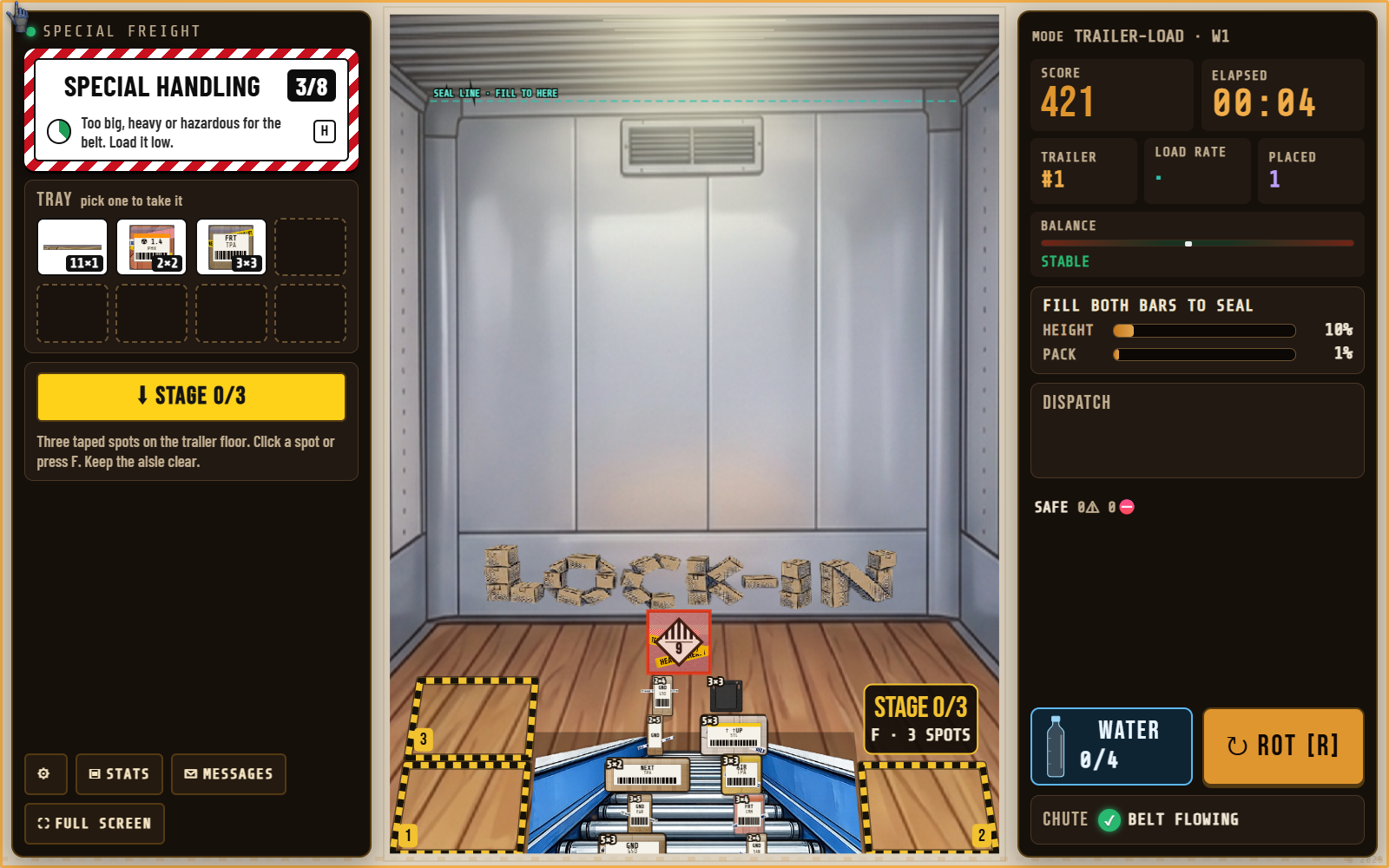
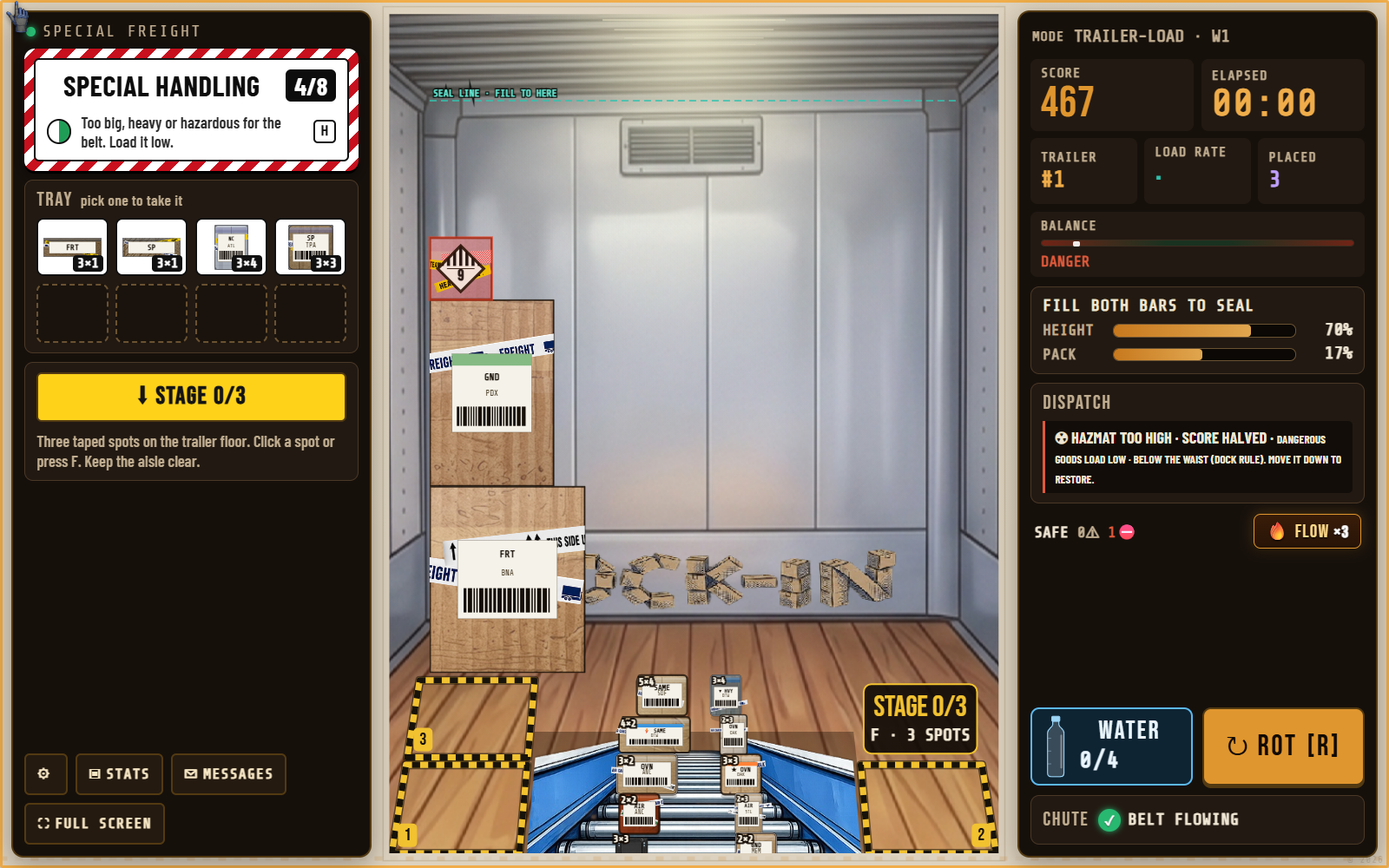
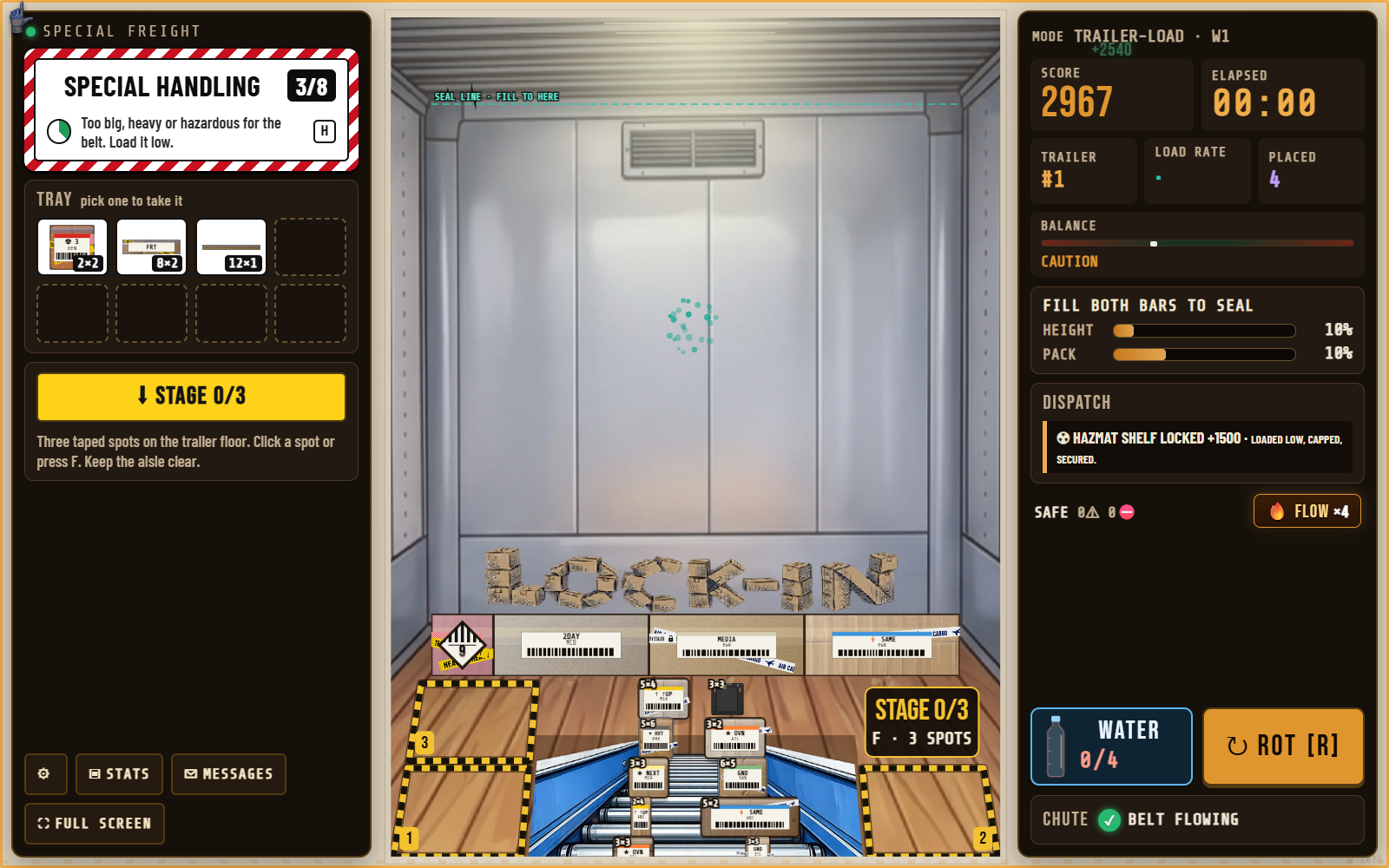
Crushing a hazmat is written up the first time it happens, and so are a hazmat above the waist line, two classes too close and a killer pair. A second stacked tire is written up too. Everything else needs a pattern before it reaches paper.
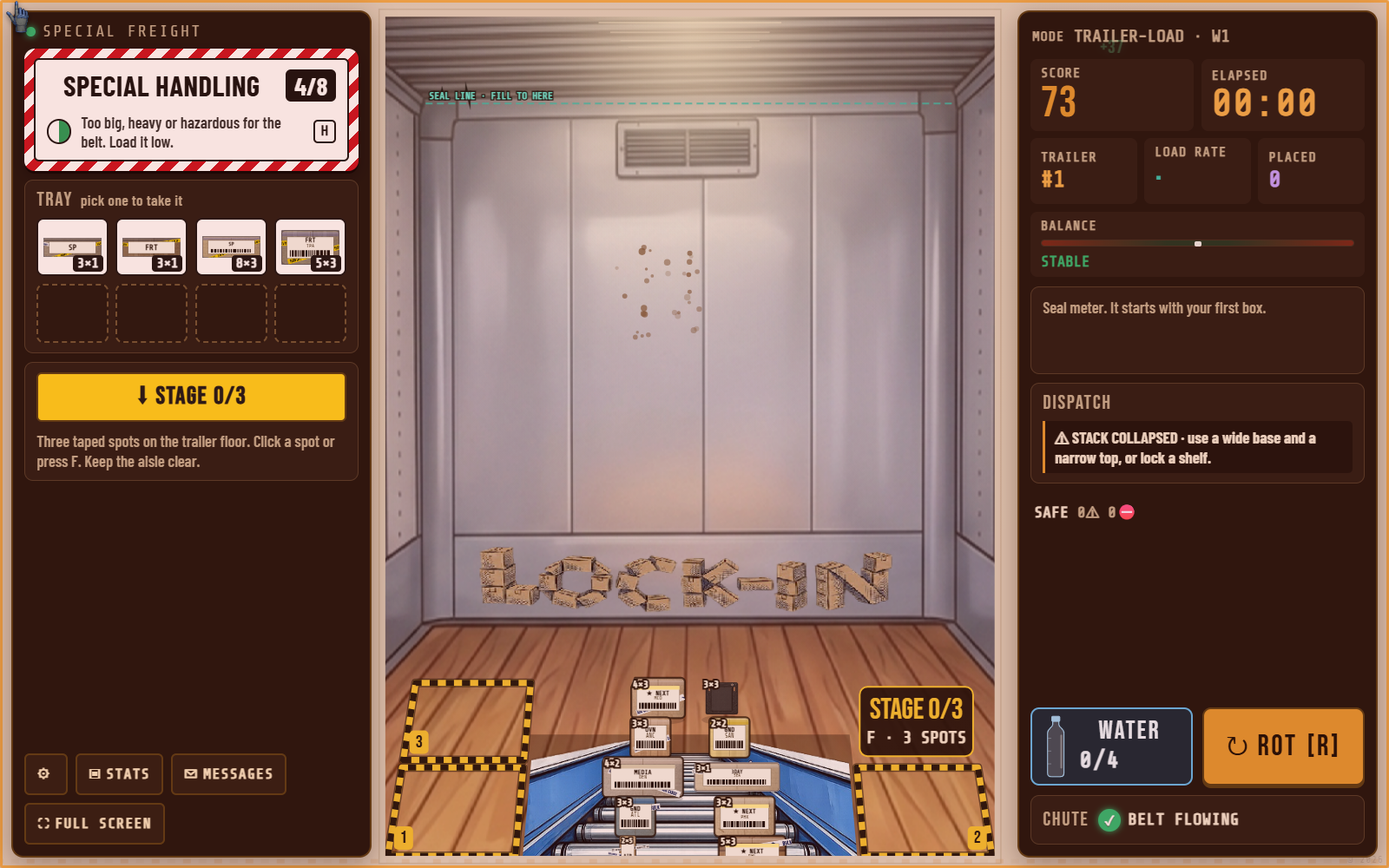
The seven ways it comes down
Every collapse in the simulator is one of these seven. Learn to recognize them and you stop having them.
1 · No support
Refused outright. Nothing breaks, you just lose the moment. This is the cheap one.
2 · A tire on its edge
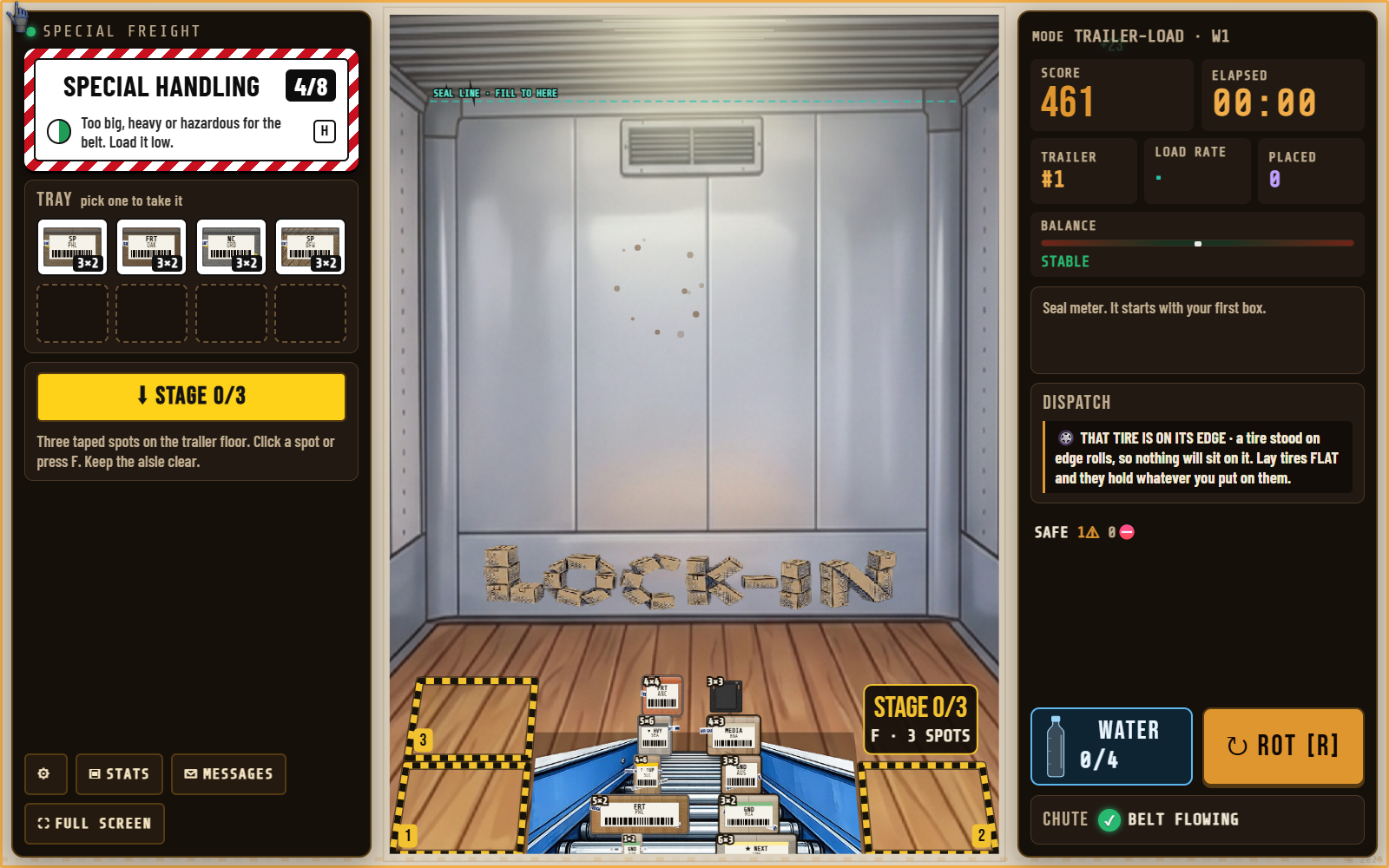
A tire standing on edge rolls. Anything placed on it topples, unless the tire is pinned: braced on both sides (the trailer wall counts) or inside a locked shelf. Lay tires flat, every time.
3 · Heavy with no base
Heavy freight needs something solid under every cell, not three quarters. It comes down, and it takes whatever it was crushing with it.
4 · Column integrity
A pillar two cells wide or narrower and four or more tall, not braced on both sides, can carry a thin piece at most half its own height. Go past that and the piece on top comes off.
5 · The staircase
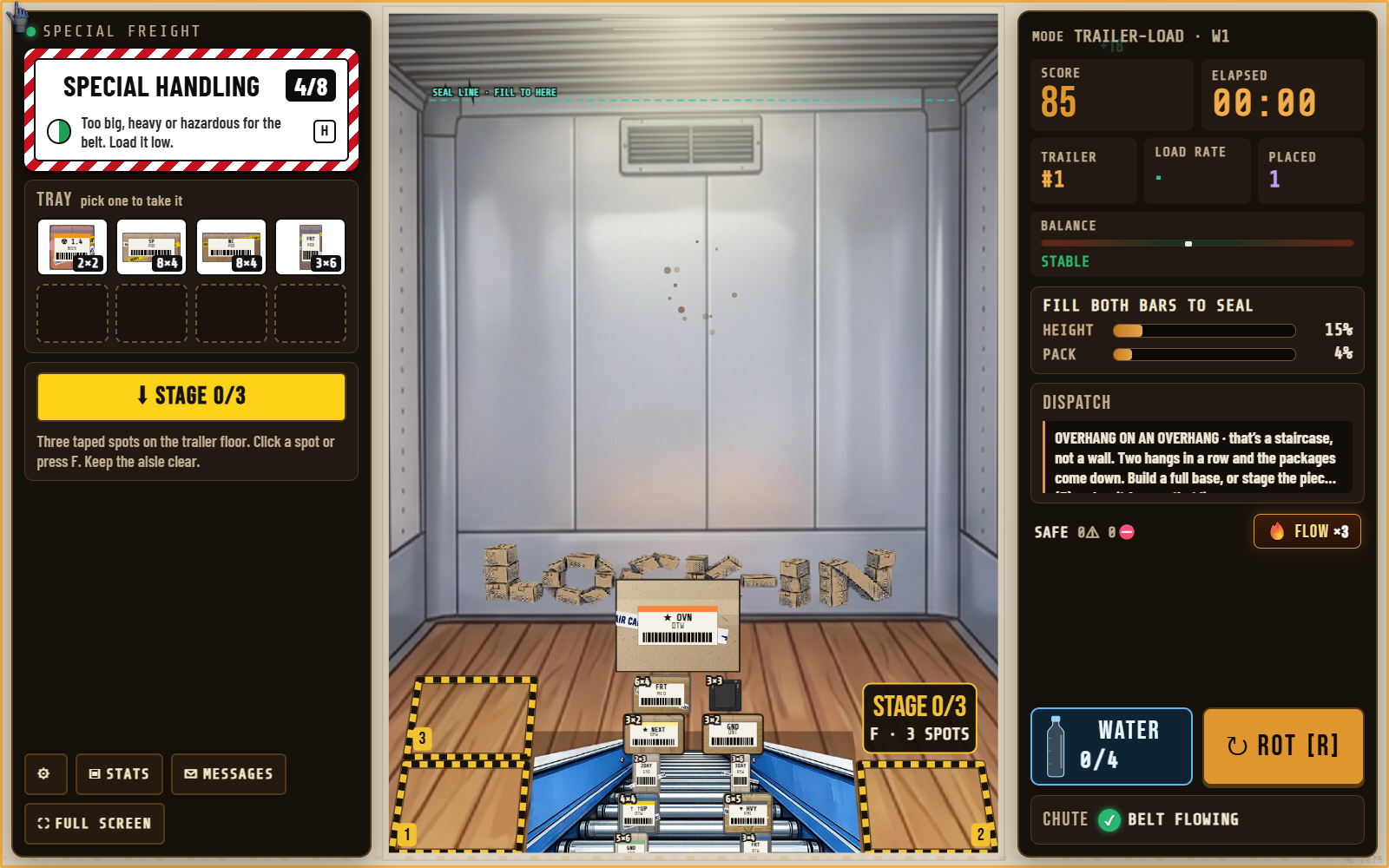
An overhang stacked on another overhang. Two hangs in a row and the packages come down. A wide flat slab, at least 2.2 times wider than tall, can overhang safely. Build a full base, or stage the piece and wait for one that lines up.
6 · The freestanding stack
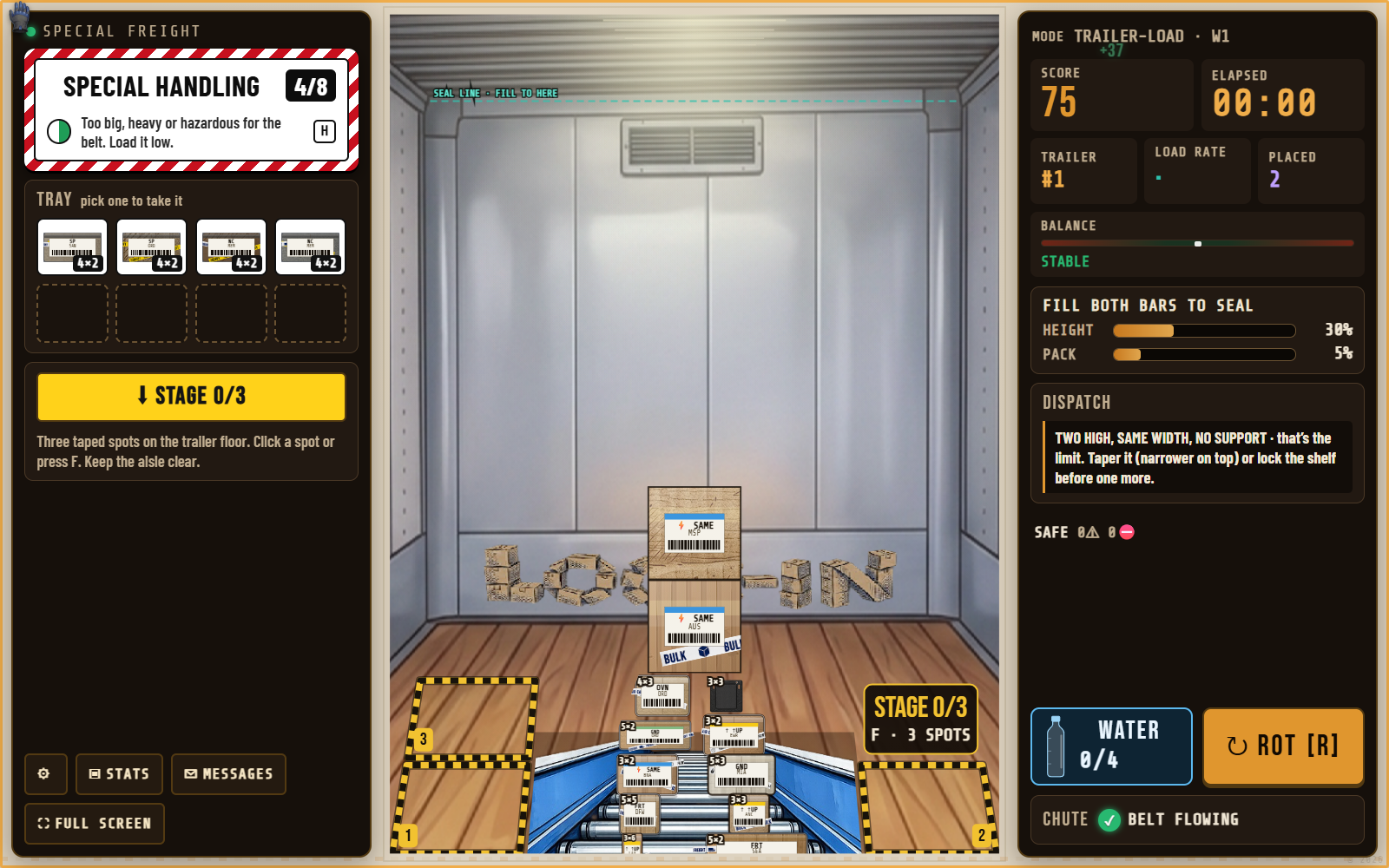
A stack counts as freestanding unless, at that level, it is touched on both sides and at least one of those sides is solid down to the floor. It goes over at four pieces, tapered or not; at three unless every piece is narrower than the one under it; at three regardless if one of them is a small or a bag; and at two once its height in cells passes what its narrowest piece can carry. Flat-laid tires never count toward a freestanding stack.
7 · The wall gives out
Integrity is how sound the whole wall is. Below 9, the top of the wall sheds a piece or two. A lone column five cells tall with nothing on either side does it, so does a piece of weight class 4 or more resting on an exposed fragile, and so does a pile of overhangs, narrow towers and voids.
The veteran moves
The things nobody writes down, which is the reason this page exists.
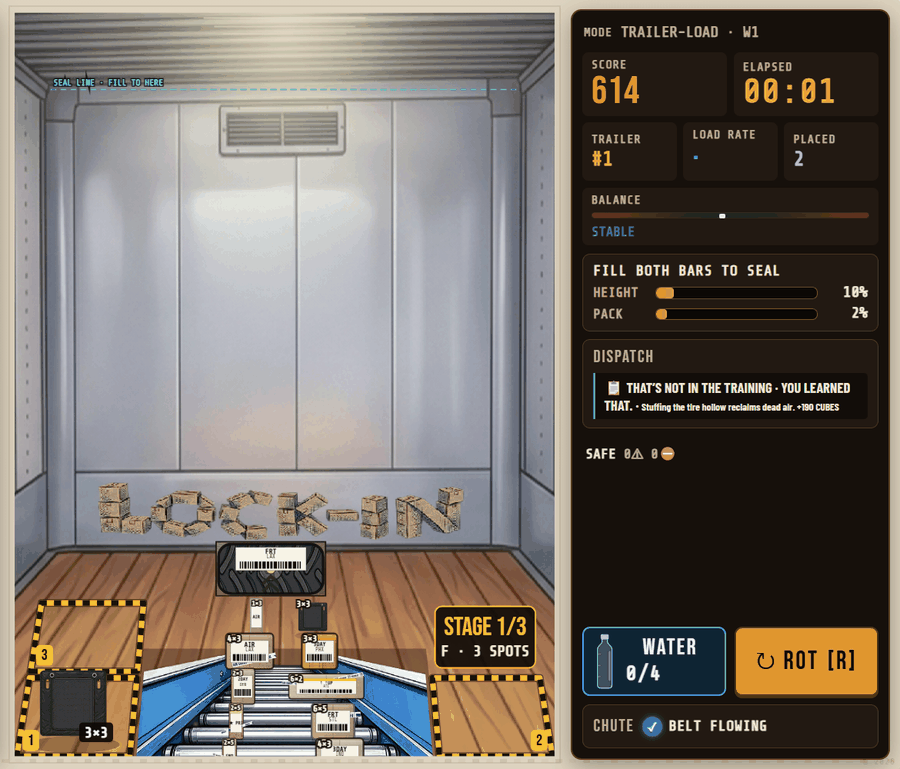
Nest smalls in a tire
A tire laid flat has a hollow in the middle, and because tire walls are thin, most of the tire is hollow: a 4 by 2 tire holds 6 cells. Same-size tires laid flat, one directly on another, share one hollow, so two of them hold 12. Stuff it. Smalls, small boxes and hazmats ride protected in there. A bag of smalls squeezes into any hollow with 9 cells of room, like a stacked pair. A box has to fit the opening: one less than the tire is wide, and as tall as the stack. Every cell you stuff pays, and a hollow filled to the rim pays a bonus for every cell in it. A hazmat rides in there only if the stack sits below the waist line.
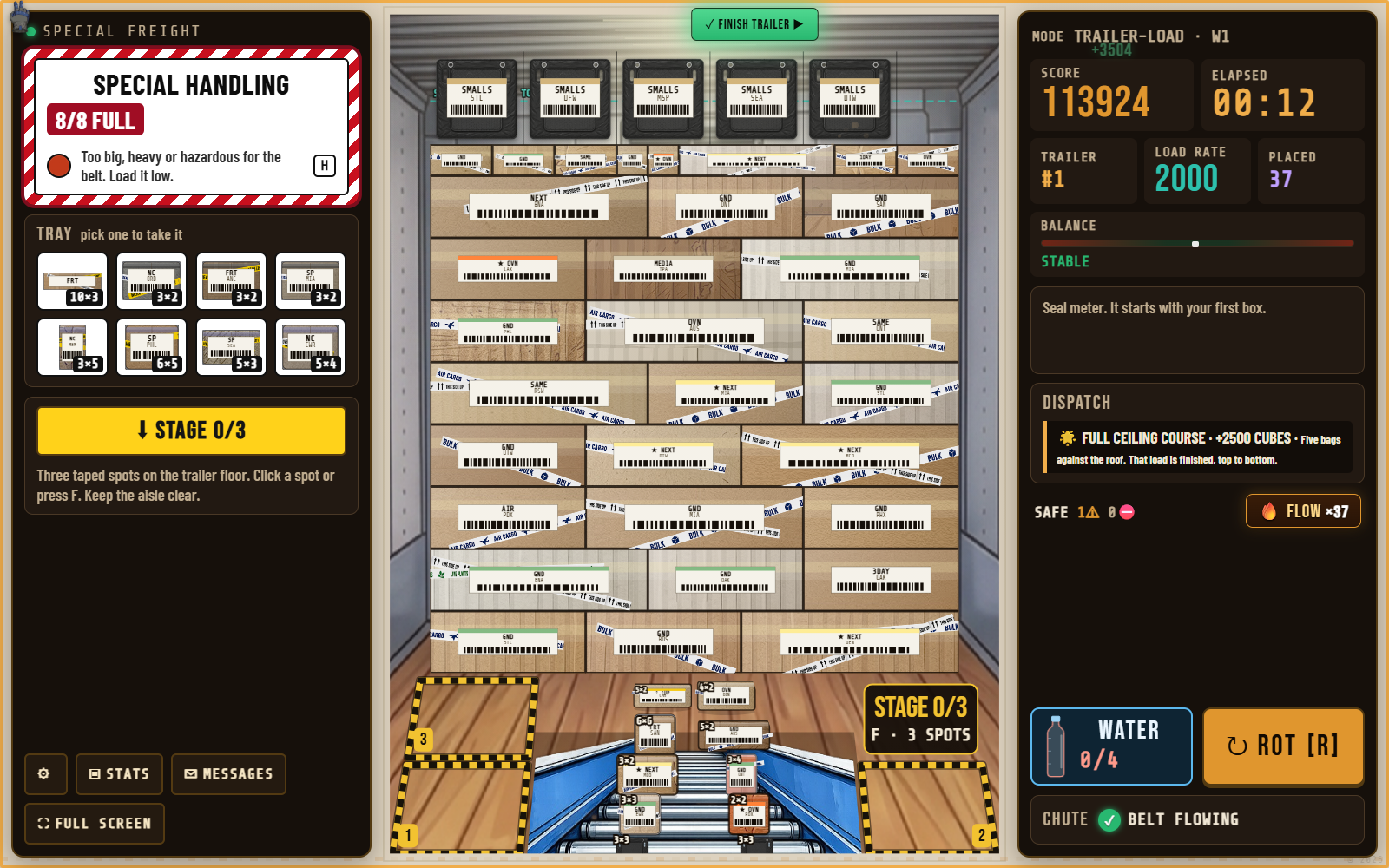
Pack the roof
The gap between the top of your wall and the trailer ceiling is wasted cube. Bags of smalls go up there. Every bag against the roof pays, and five of them make a full ceiling course, which pays a bonus on top.
Early in the wall, bags are rare. Later in the truck more smalls have been processed, and near the top the NC guy looks out for you: when your wall passes 70% height, and again at 85%, he hands you a bag at the front of the chute, and a special-handling piece too big for the room you have left goes to the other door with a bag sent in its place. That is your chance to finish off the load with no gaps. Be quick about it: smalls never count toward your rate. A bag that comes down before you are ready for it can be staged and saved for the roof.
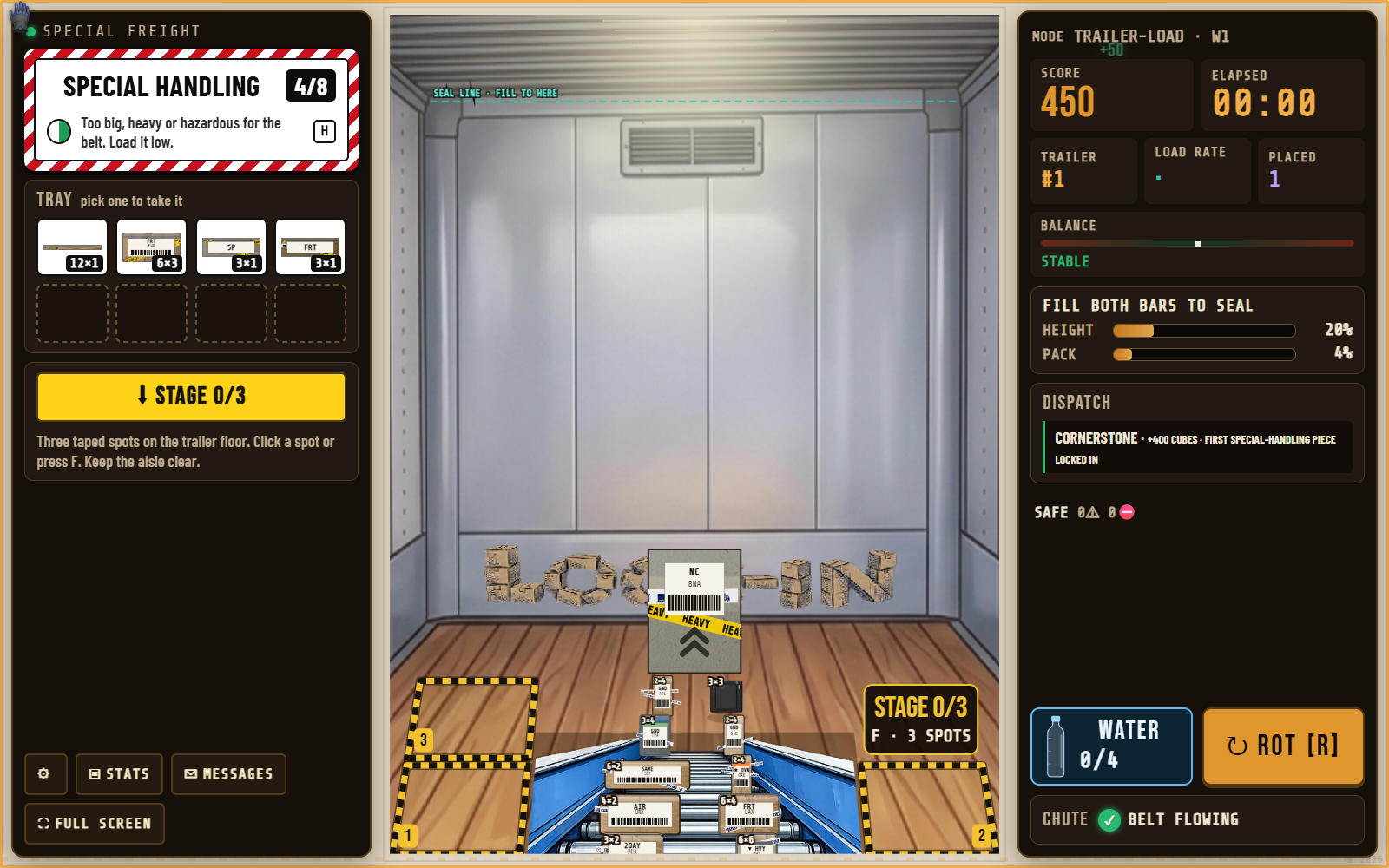
Anchor your non-conveyables
Appliances, furniture and tires do not stack like boxes, so put them where the trailer itself braces them. The first one you place anchors the whole load. One touching two edges at once is better still.
Staging
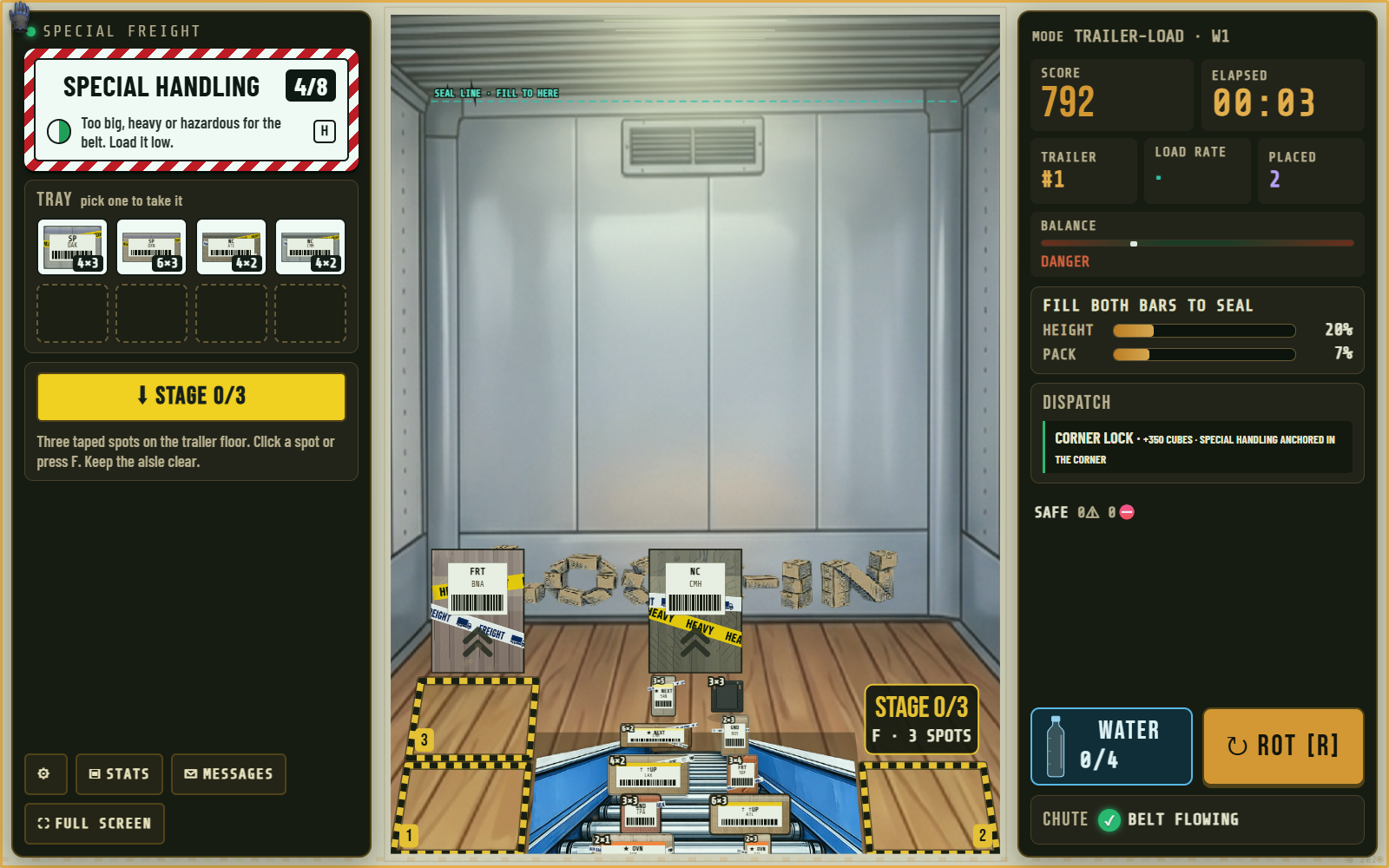
A box that does not fit yet does not have to go on the wall. Press STAGE, or F, and set it down on the staging floor beside the wall. There are three spots. Press F with empty hands to pick the oldest one back up.
Keep the aisle clear: if all three spots stay full while you load five more boxes, that is a safety warning, and the fix is to clear a spot: load a staged box, or break down a staged bag. Staged boxes ride along to the next wall. Any still sitting there when your shift ends were left on the dock, and each one costs 100 cubes.
Pace
Two hundred and fifty pieces an hour. That is the hub standard, and it counts freight only.
Smalls do not count toward your rate. Neither do bags. Stopping to break down a bag of smalls to fill your gaps is time you are not moving freight, and the clock keeps running while you do it.
It works this way on the floor for the same reason. A supervisor counts pieces, and a bag of smalls is one piece whether you place it whole or spend four minutes distributing it.
Flow
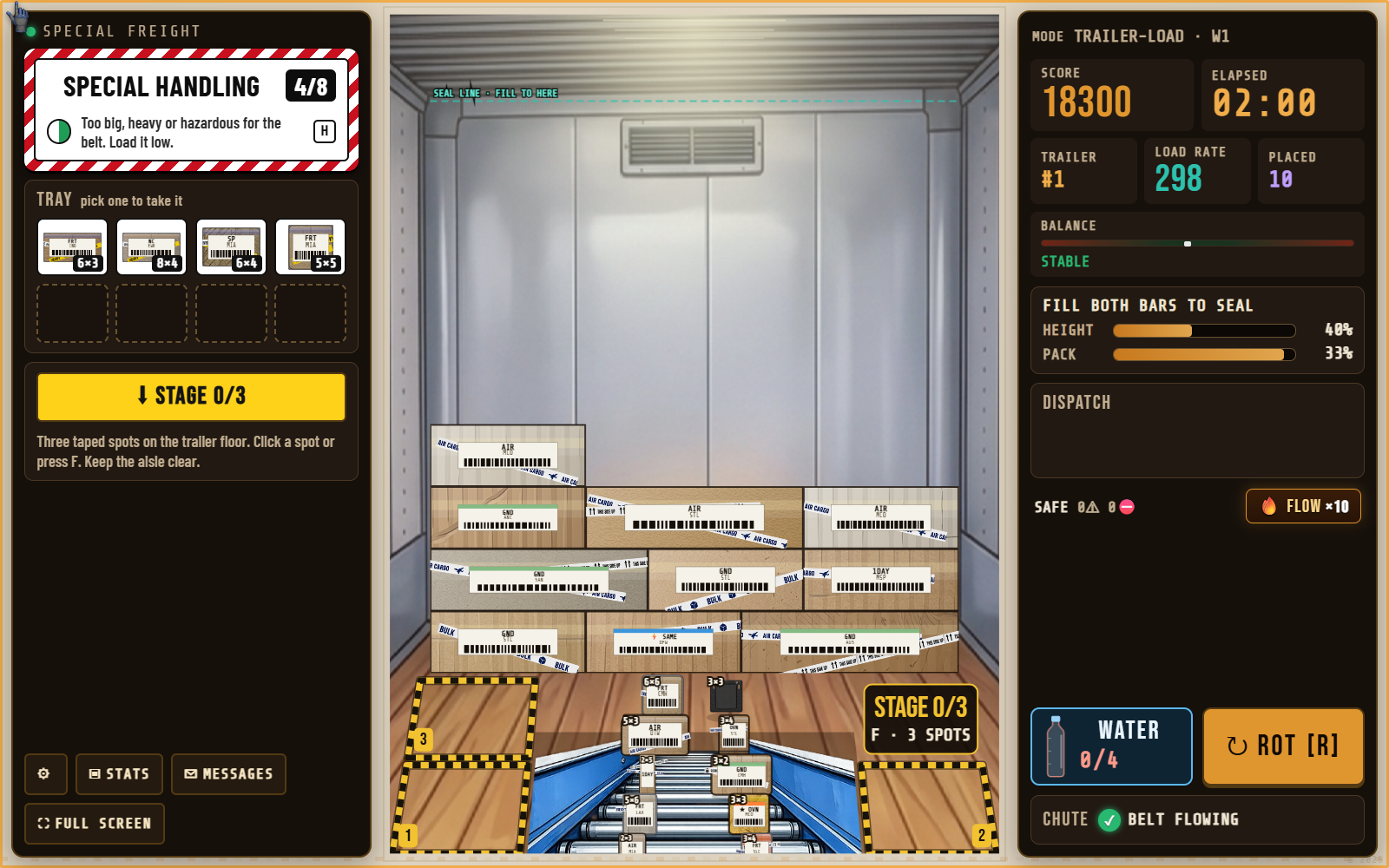
Clean placements in a row build a streak that pays more the longer it runs. A crush resets it to nothing, and so does a collapse of three or more pieces. One or two pieces coming loose is a slip, and a slip leaves the streak alone. Steady beats frantic.
The record
The simulator separates a mistake from a pattern, because a workplace does.
- One broken box is a mistake. It costs you, it breaks your streak, and that is the end of it. It is not a safety event.
- A third broken box in a shift starts the ladder. Eyes go on you when the freight keeps getting damaged, not when some does.
- A warning needs a repeat to become an incident. Paper lands on a pattern.
- You can wash a warning before it repeats. Locking a new shelf washes a sideways-tire or crushed-fragile warning. Water washes a hydration warning, and clearing a staging spot washes a blocked aisle. The record still shows it was washed. A collapse warning cannot be washed: the next collapse is an incident.
Dispatch
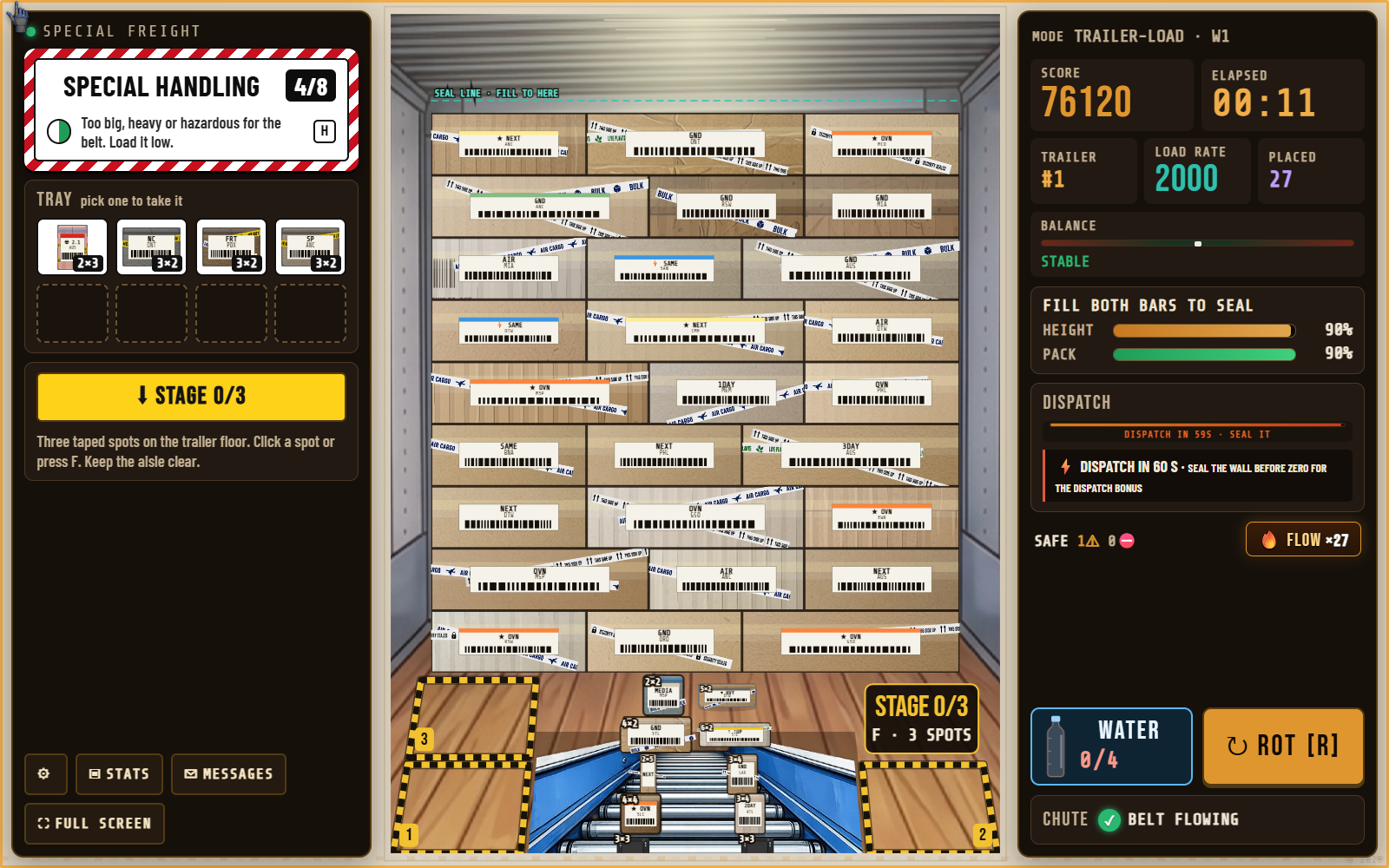
Once the wall is 85% full or 85% high, the truck is waiting and a 60-second dispatch clock starts. Seal it before zero and you are paid up to 800 for it. In TRAILER-LOAD, miss it and the trailer is late: that is a strike (see Clocks below), and you still finish the wall.
Jams
An empty chute is a jam, and breaking it is your job: press BREAK JAM (or B) and freight starts moving again. In TRAILER-LOAD, leave it 11 seconds and the manager has to stop what they are doing to break it for you. That is a strike.
Clocks
In TRAILER-LOAD no clock ends your shift. A missed dispatch, a jam the manager breaks, special handling left full, heavy freight left high with no base for 30 seconds, a load rate under 55 for three minutes, or five idle minutes is a strike. A warning comes first. The first strike of a kind costs 5,000, the second 10,000, and the third and every one after 20,000 and a write-up. Four write-ups end the shift. A strike comes off the wall's score and then the shift total, and never takes either below zero. A pause stops every clock.
The certificate
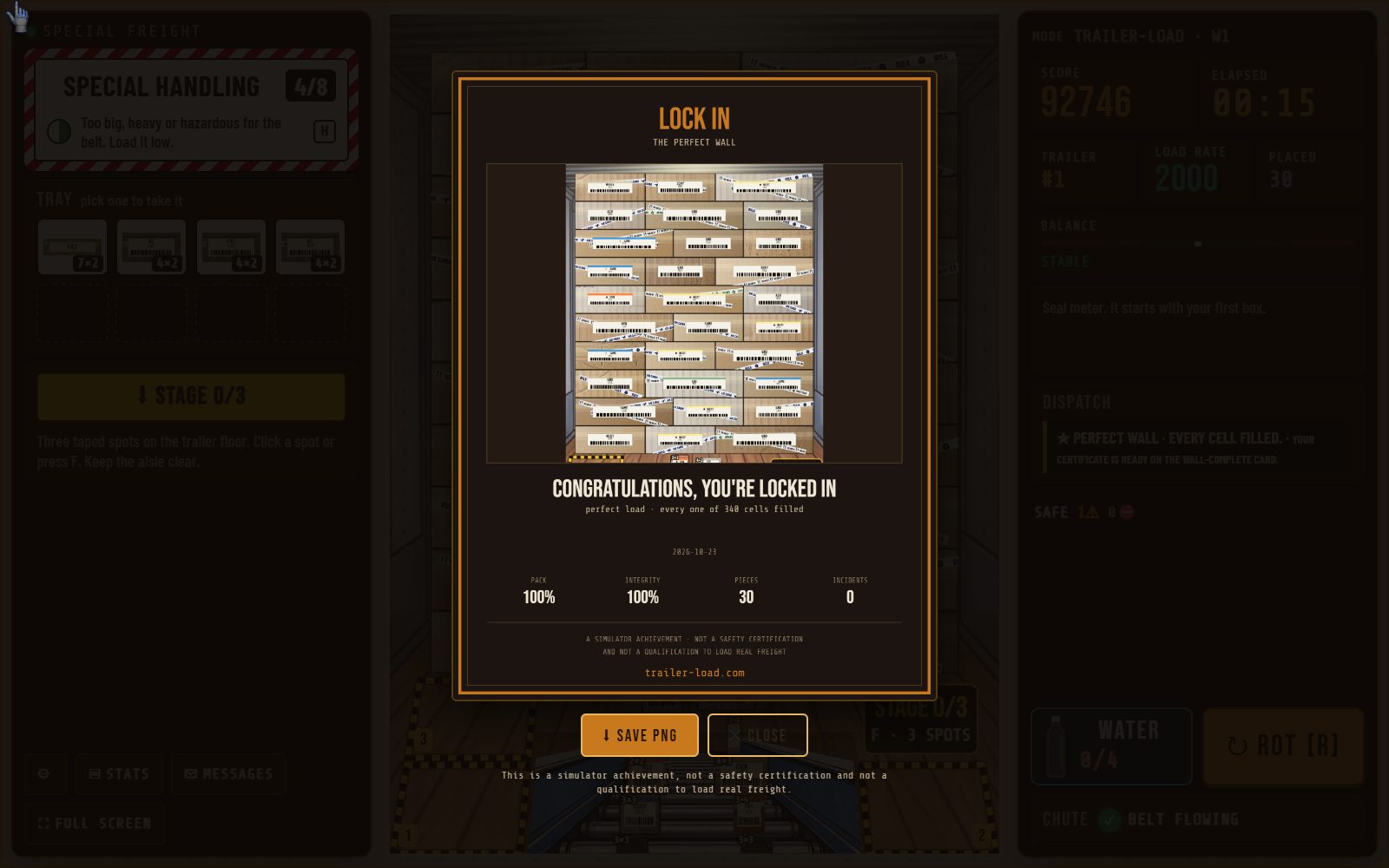
The hardest thing in the simulator, and it is deliberately hard. It needs a wall to the ceiling, packed tight, at full integrity, with zero collapses and zero incidents. Not a good wall. A perfect wall. It is graded when you finish the wall: when it seals, choose CONTINUE LOADING, fill it to the ceiling, then press FINISH TRAILER.